Two Claude Code plugins now show more than a million installs each on Anthropic's plugin directory. Anthropic's Frontend Design shows 1,134,112 and the community-built Superpowers shows 1,009,371, as of November 25, 2026. Nothing else on our list comes close: the next one, Code Review, has 438,525.
That gap is useful information. With hundreds of plugins to choose from, most people end up installing the same handful. We read the install counts on 19 plugin pages, opened each plugin's source, and sorted them into the ones worth adding and the catches you should know about first.
What is a Claude Code plugin?
A plugin is a bundle that adds abilities to Claude in one install. Anthropic's docs describe it as "a directory of components, usually with a manifest." Those components can be skills (instructions Claude loads when they fit the task), subagents, hooks that fire on events such as finishing a turn, and MCP servers that connect Claude to outside tools. The install page also lists commands and LSP (language server) servers.
Claude Code ships with Anthropic's official marketplace already added. Installing takes one line in a session:
/plugin install superpowers@claude-plugins-officialYou can install a plugin for yourself across every project, for everyone on a repository (it is written into the committed .claude/settings.json), or just for you in one repository, per the docs.
If you came here from our trending GitHub repos roundup, this is the same shift from the other side: developers are shipping skills and plugins, not standalone tools.
Which Claude Code plugins have the most installs?
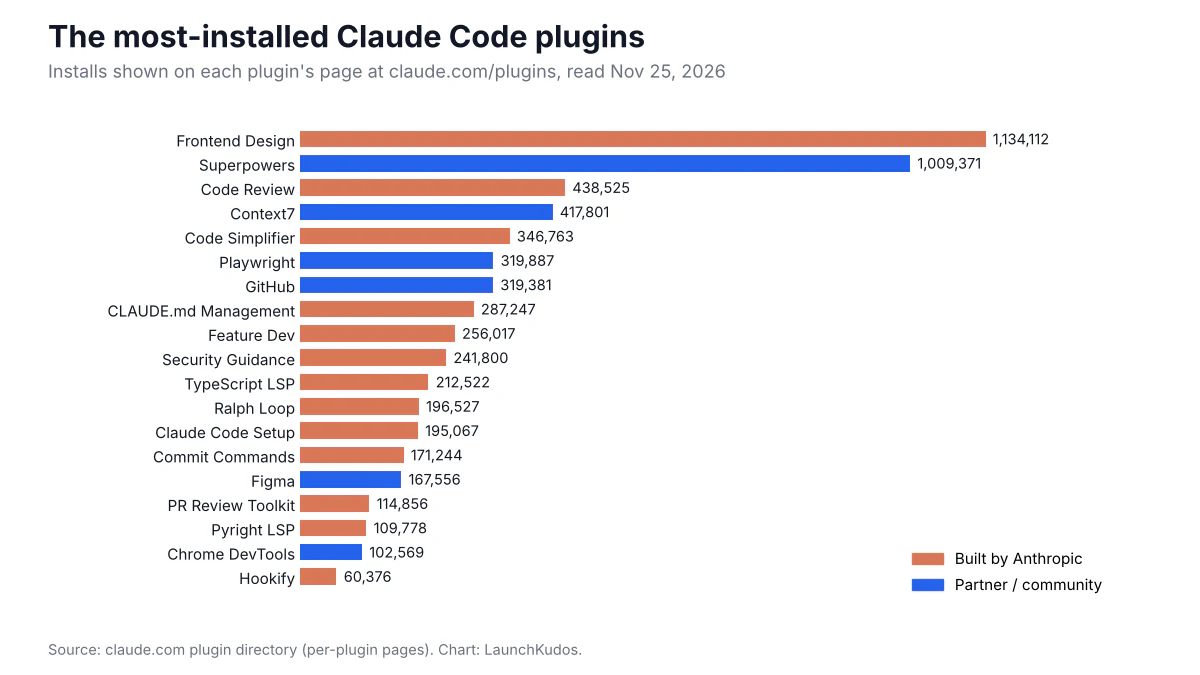
These are the numbers printed on each plugin's page at claude.com/plugins. The directory does not say how it counts an install or whether removals are subtracted, so treat them as a measure of reach, not of daily use. Thirteen of the 19 were built by Anthropic. Five of the other six come from companies connecting their own products (Upstash, Microsoft, GitHub, Figma, Google). Superpowers is the exception: a workflow plugin from outside Anthropic that nearly tops the chart.
The three we would install first
Superpowers: a method, not just a tool
Superpowers is a set of skills that changes how Claude works through a task. Its README says that when you start building, it "doesn't just jump into trying to write code." It asks what you are trying to do, shows you a spec in short chunks, writes a plan, and then runs the plan through subagents that each take one task and get reviewed. The skills cover test-driven development, a four-phase debugging process, writing plans, and checking work before calling it finished.
The README says the agent can often "work autonomously for a couple hours at a time without deviating from the plan." That is the project's claim. We have not measured it.
Our take: this is the plugin to install if Claude keeps writing code before it understands the problem. It slows the first few minutes down and saves the hour you would have spent undoing a bad start. It also works outside Claude Code: the README has install steps for Codex, Cursor, Gemini CLI, GitHub Copilot CLI and others.
Code Review: four reviewers and a confidence filter
Anthropic's Code Review plugin adds a /code-review command. It launches four agents in parallel: two check the change against your CLAUDE.md rules, one looks for bugs, and one reads git history for context. Each finding gets a 0 to 100 confidence score, and anything under 80 is dropped. By default the review prints in your terminal. Add --comment and it posts on the pull request instead.
Our take: the confidence filter is why it's worth using. Review bots that report everything get ignored after a week. It also skips draft, closed and already-reviewed pull requests on its own.
Context7: docs from this year, not from training data
Context7, from Upstash, fetches "up-to-date, version-specific documentation and code examples" for the library you're using and puts them in Claude's context. It fixes a common failure: the model confidently writes code against an API that changed after its training cutoff. It works without an account, but the README recommends a free API key "for higher rate limits."
Our take: install it if your stack moves fast (Next.js, Supabase, any AI SDK). For a stable language standard library it adds little.
What about Frontend Design, the plugin with the most installs?
Frontend Design is a single skill. It pushes Claude toward "bold aesthetic choices," distinctive typography and color, and away from the generic look AI-built pages tend to share. Claude uses it automatically for frontend work. There is no command to remember.
Our take: if you build landing pages or app screens with Claude, install it. It is the cheapest upgrade on this list because it changes the output without changing how you work. If you only write backend code, skip it, whatever its install count says.
Which plugins make Claude safer to run?
"Whatever the tier, a plugin you install can run code with your user privileges."
Security Guidance (241,800 installs) works in three layers. It gives instant warnings on about 25 dangerous code patterns, such as pickle.load on untrusted data or hardcoded secrets. When Claude finishes a turn, it runs a model review of the diff. On git commit, an agent reads the related files to catch bugs that span several files, such as authorization bypasses and server-side request forgery (SSRF). It needs Python 3.8 or later and Claude Code 2.1.144 or later. The two model reviews run on your Claude sign-in or API key, so they use your tokens.
Hookify (60,376 installs) turns a plain-English rule into a hook. Its own example is /hookify Warn me when I use rm -rf commands. Rules live in small markdown files you can turn on and off without restarting.
Our take: Security Guidance belongs next to Code Review on any repo that handles user data. Hookify is for the moment you catch Claude doing the same wrong thing twice.
The rest of the list, by job
| Plugin | Installs | What it does | Install it if |
|---|---|---|---|
| Code Simplifier | 346,763 | An agent that cleans up recently changed code without changing what it does | Claude's code works but reads badly |
| Playwright | 319,887 | Microsoft's browser automation: click, fill forms, screenshot, test | You want Claude to test your web app itself |
| GitHub | 319,381 | GitHub's official server for issues, pull requests and code search | Your work lives on GitHub |
| CLAUDE.md Management | 287,247 | Audits your CLAUDE.md against the code and saves what a session learned | Your project rules file is going stale |
| Feature Dev | 256,017 | A seven-phase /feature-dev flow: explore, ask, design, build, review | You want structure but not all of Superpowers |
| TypeScript LSP | 212,522 | A language server, so Claude sees type errors and definitions | You write TypeScript (13 language servers are offered, from Python to Rust) |
| Ralph Loop | 196,527 | Feeds Claude the same prompt again until it prints a "done" phrase | You have a long task with tests that can tell when it is finished |
| Claude Code Setup | 195,067 | Reads your repo and recommends hooks, skills and servers; changes nothing | You are new to Claude Code |
| Figma | 167,556 | Reads design files, components and design tokens | Your designs start in Figma |
| PR Review Toolkit | 114,856 | Six focused reviewers: comments, tests, error handling, types | You want deeper review than Code Review gives |
| Chrome DevTools | 102,569 | A live Chrome: console, network, performance traces | You debug slow or broken pages |
Ralph Loop needs one warning. Its own quick-start example sets --max-iterations 50. Always set a limit, because the loop keeps going, and spending tokens, until it sees the completion phrase.
What should you check before installing a plugin?
The install screen tells you to look before you click: "A plugin can run hooks and MCP servers, so read the pane before you install," say the docs. Three things are worth a minute:
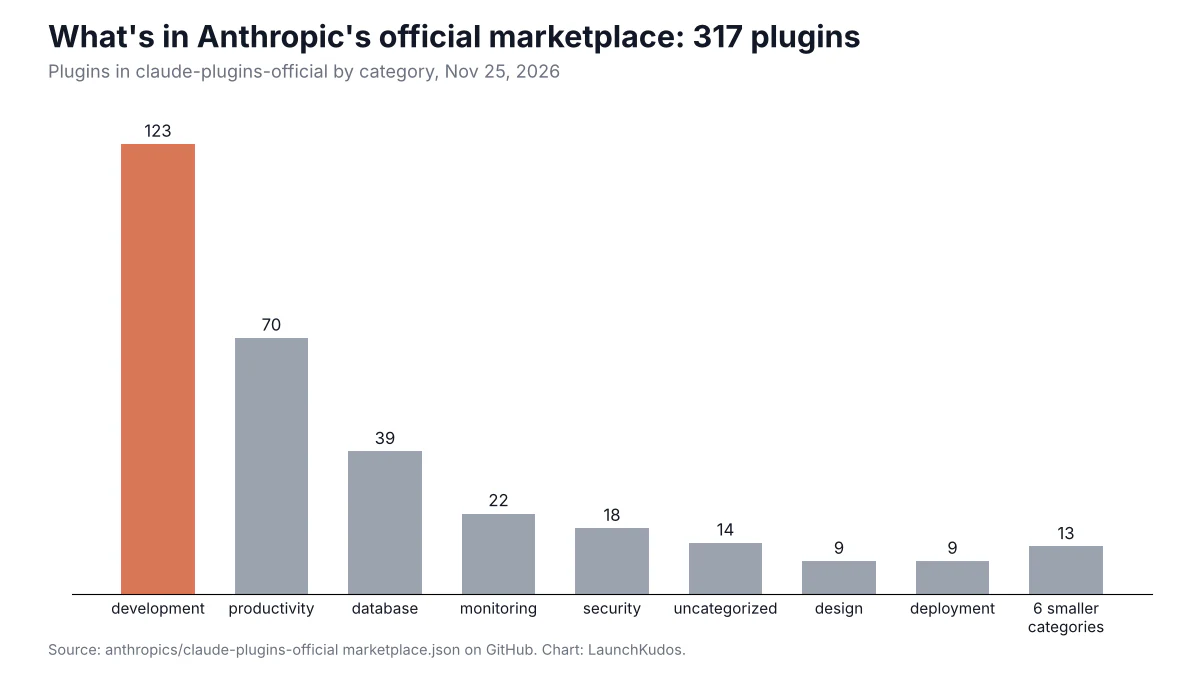
- Who maintains it. Anthropic built 41 of the 317 plugins in its official marketplace file. The rest point to repositories run by their authors, so read the source.
- What it sends out. Chrome DevTools for agents says Google collects usage statistics and that collection is "enabled by default";
--no-usage-statisticsturns it off. Superpowers' optional visual companion loads its logo from the maker's site, which tells them the version in use;SUPERPOWERS_DISABLE_TELEMETRYturns that off. (Telemetry in developer tools has caused fights before; see the T3 Code controversy.) - Where you enable it. Project scope puts the plugin in front of everyone who clones the repo. Use user or local scope until you trust it.
Are there plugins for people who don't code?
Yes. Plugins came to Claude Cowork, Anthropic's agent for office work, on January 30, 2026. TechCrunch reported that Anthropic "open sourced 11 of its in-house plug-ins" with the release. The knowledge-work-plugins repository lists them: productivity, sales, customer support, product management, marketing, legal, finance, data, enterprise search, bio-research and plugin management.
On February 24, Anthropic added private plugin marketplaces for company admins and new templates for HR, design, engineering, operations and several finance roles. In Anthropic's words, plugins "turn Claude into specialized agents for every role and department." The repository's README says the plugins also work in Claude Code.
FAQ
How do I install a Claude Code plugin?
In a Claude Code session, run /plugin install <name>@claude-plugins-official, for example /plugin install code-review@claude-plugins-official. The official marketplace is added by default. For another marketplace, add it first with /plugin marketplace add <owner/repo>.
What is the most popular Claude Code plugin?
Of the 19 plugins we checked, Frontend Design, with 1,134,112 installs on its directory page on November 25, 2026. Superpowers was second with 1,009,371. The directory does not publish a ranking, so a plugin we did not check could have more.
Are Claude Code plugins safe?
A plugin runs with your user permissions, so it is as safe as its author and its code. Anthropic's docs say to read the install pane before installing. Prefer plugins built by Anthropic or by the company whose service it connects to, and read the source of anything else.
Do plugins cost extra?
None of the plugins on this list charges to install, and their code is public on GitHub. Some use your Claude tokens when they run: Security Guidance's model reviews, Code Review's agents and long Ralph Loop runs all do. Plugins that connect to a paid service, such as Figma or Vercel, need an account there.
Can I use Claude Code plugins in Cowork?
Cowork has its own plugins, built for roles such as sales, legal and finance. The knowledge-work-plugins README says they also work in Claude Code.
Reader poll
Which Claude Code plugin would you install first?
Vote to see results.
- #claude-code
- #claude-plugins
- #anthropic
- #developer-tools
- #ai-agents