Nvidia Reinstates Jensen Huang: What AI Founders Should Watch
Nvidia's board reversed itself in six days and NVDA closed up 31.5%. What it changes for AI startups: GPU supply, key-person risk and launch timing.
By Arnab Gupta · · 5 min read
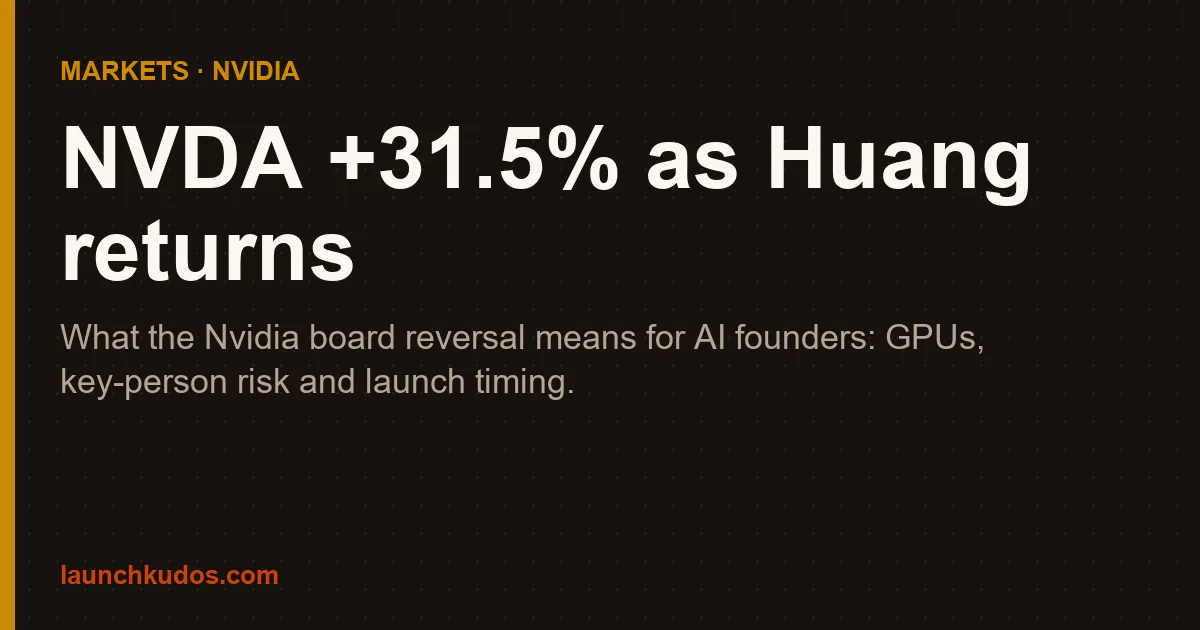
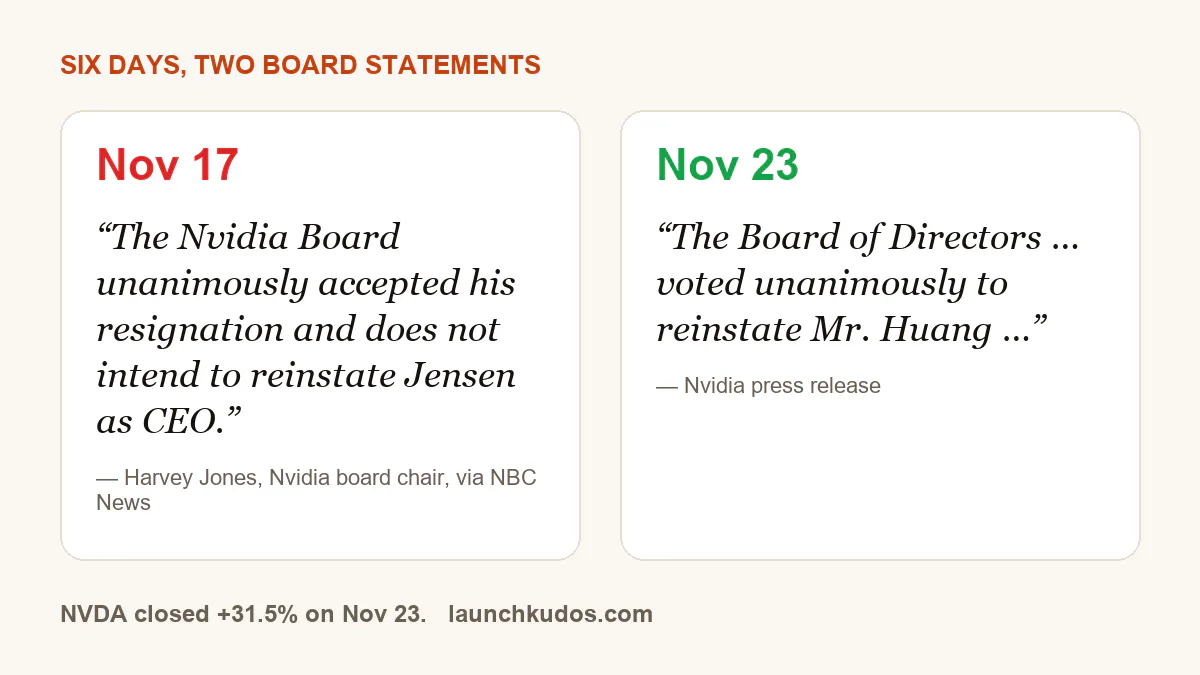
On Monday, November 23, Nvidia's board voted unanimously to reinstate Jensen Huang as president and CEO. Less than two weeks earlier he had resigned. Six days earlier, the board's chair had said in writing that he wasn't coming back.
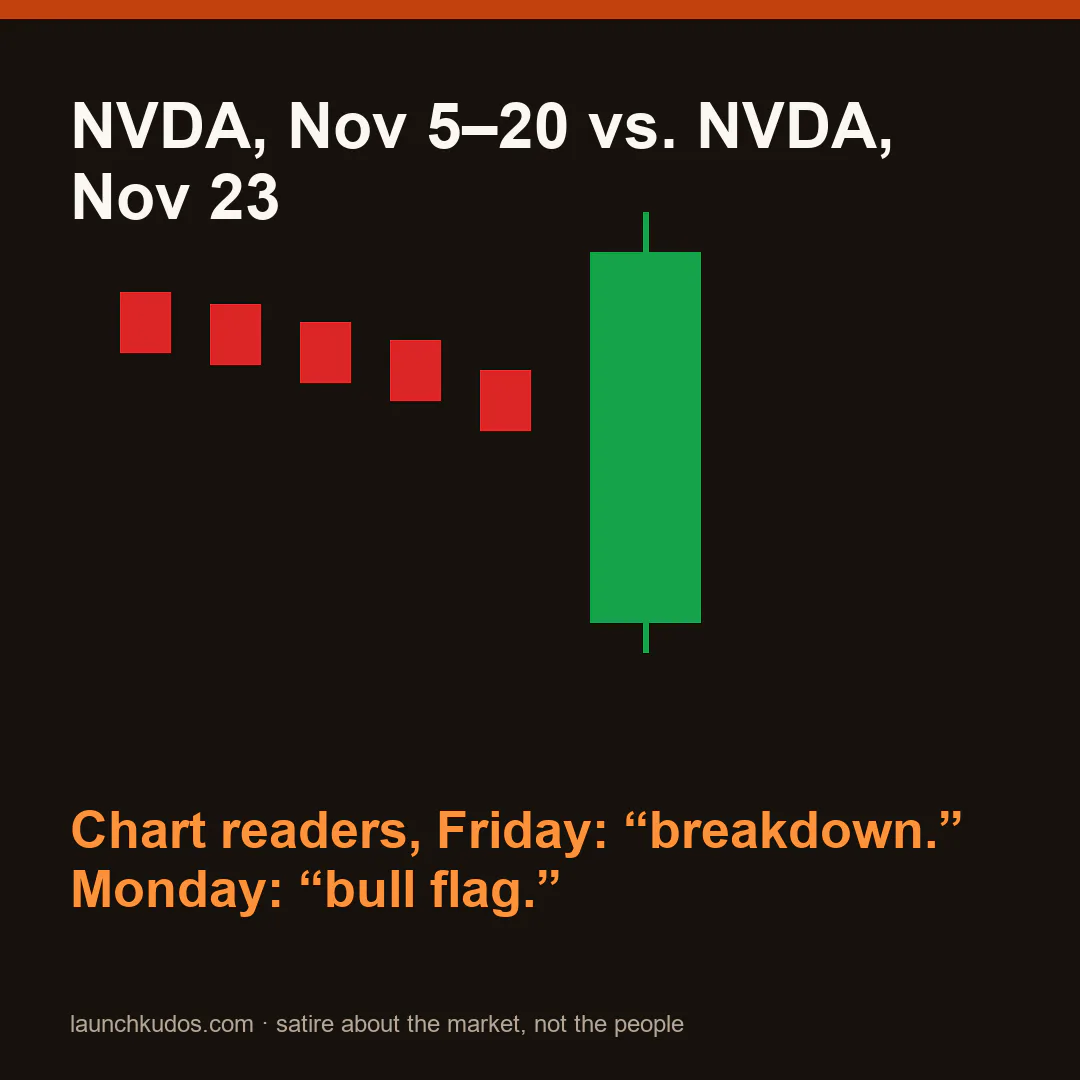
The stock went from $125.53 at Friday's close to $165.05 at Monday's. That is 31.5% in one session, for a company most AI startups depend on whether they think about it or not.
This post sticks to what's on the record, then looks at the parts that matter if you build or launch AI products. Where we're giving an opinion, we say so.
What happened, in order
Huang stepped down after reports that he had an affair with a woman U.S. intelligence believes to be a Chinese spy, per NBC News. China's foreign ministry dismissed the spying claims as a smear campaign. CFO Colette Kress ran the company as interim CEO.
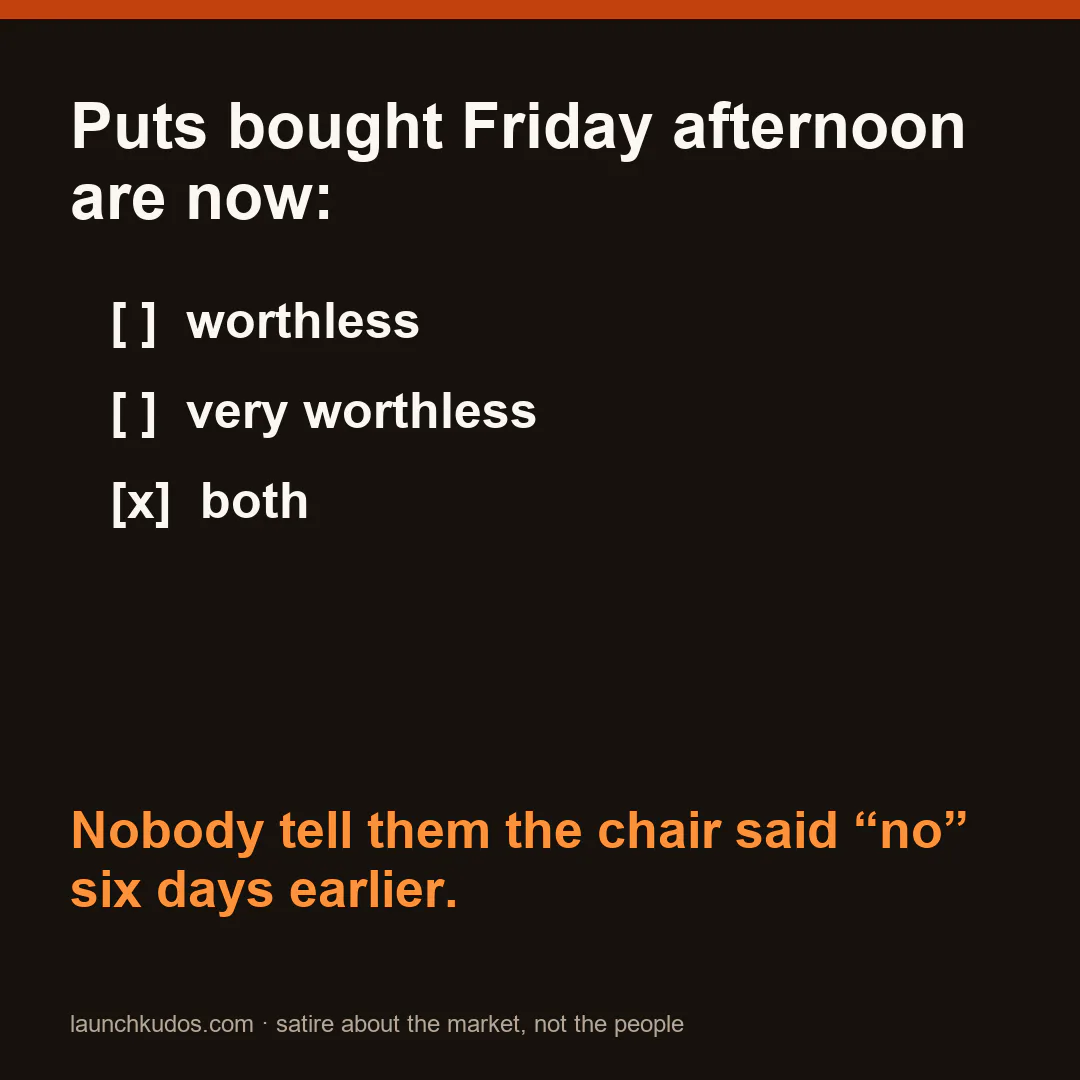
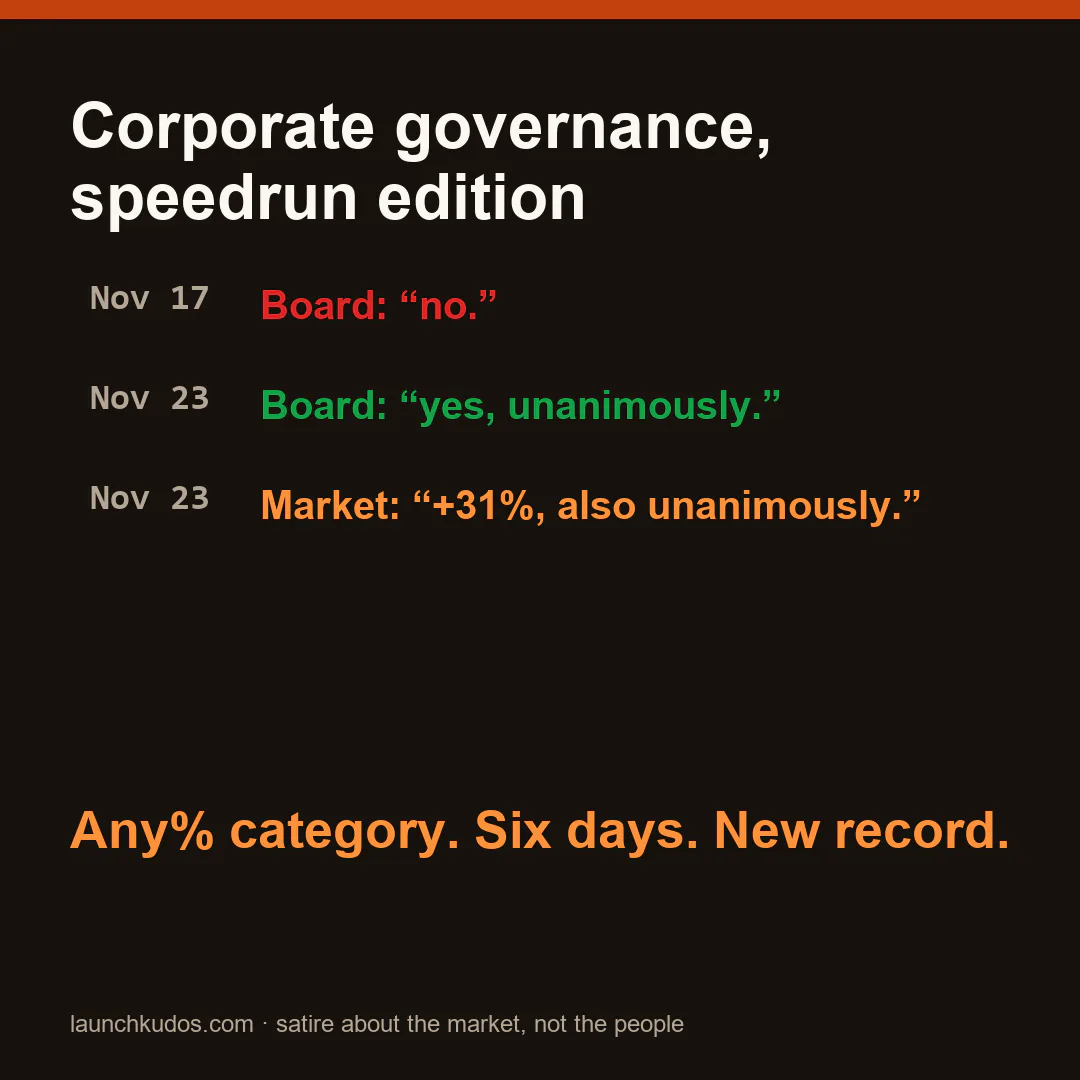
On November 17, chair Harvey Jones said the board "does not intend to reinstate Jensen as CEO," according to NBC News.
On November 23 the board reversed course. Its statement says it "received input from senior levels of the United States government" and that, based on that input, it is confident the reinstatement "poses no national security risk." It also says the board "was satisfied with respect to Mr. Huang's candor and ability to lead NVIDIA." Jones stays on as chair. Kress goes back to being CFO only.
President Trump told CNBC in a phone interview, as quoted by ABC News: "I spoke to them. Let me put it this way: And I convinced them. I made the deal."
Not everyone in Washington agreed with the White House. Sen. Pete Ricketts (R-Neb.) wrote on X that Huang's "behavior does not support reinstatement," and that the decision "doesn't absolve Nvidia of answering for national security concerns and unaccounted-for chips." Huang is scheduled to be the sole witness at a Senate Banking Committee hearing on December 3, titled "Protecting America's AI Advantage: Oversight of U.S. Export Controls." NBC reports he and Nvidia's general counsel also have transcribed interviews with House committees on December 1 and 2.
How the market took it
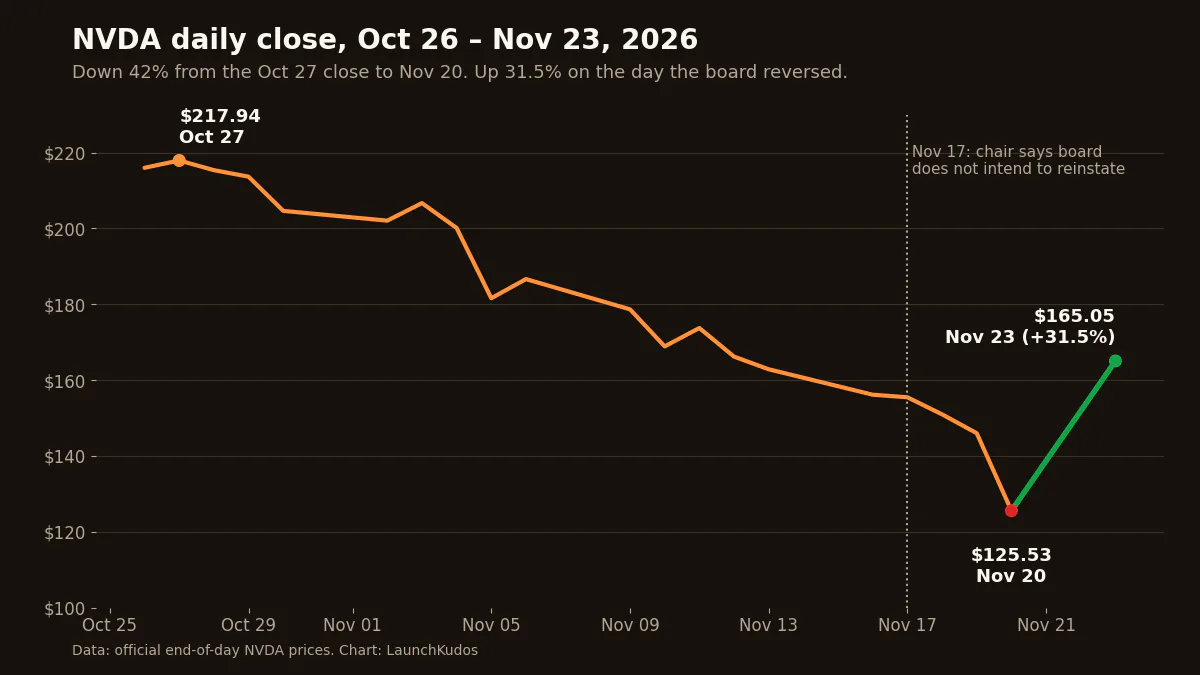
The numbers, from Nvidia's daily price history:
- Oct 27 close: $217.94
- Nov 20 close: $125.53, which is 42% below that
- Nov 23 close: $165.05, up 31.5% on the day and still 24% below Oct 27
- Nov 23 volume: about 781 million shares, the heaviest of the month
It dragged the whole market with it. Yahoo Finance's markets desk reported the S&P 500 up 4.7% and the Nasdaq up nearly 6.5%, the best day for the indexes since April 2025.
Analysts welcomed the CEO and panned the board. Bernstein's Stacy Rasgon upgraded the stock back to Outperform, and also called the board's on-again, off-again handling "frankly, clown-like," per Yahoo Finance's live coverage.
What it means for AI startups
GPU supply and pricing
Our take: a CEO swap does not move fab capacity in a quarter. If your GPU bill changes in the next few months, the leadership drama is unlikely to be the reason. Export controls are the variable we'd actually watch.
The record points there too. The board's statement announces a new National Security and Export Control Committee and a search for a Chief Compliance Officer. NBC reports that Megaspeed, the Singapore company tied to the woman at the center of the reports, reportedly acquired billions of dollars of Nvidia chips and is being investigated over smuggling concerns. Nvidia disputes that Megaspeed diverted chips to China. Sen. Kevin Cramer, quoted by ABC, wants Congress to "immediately pass the strictest export controls possible."
What we'd do as a founder:
- If you rent GPUs from a reseller or a small cloud, ask where the hardware came from and what region it sits in. If tighter rules land, the gray-market capacity goes first.
- Don't sign a long prepaid compute deal this week because of a headline. Wait until after December 3.
- If a provider raises prices and blames "Nvidia uncertainty," ask what changed in their costs. We have seen no data that cloud GPU rates moved this week.
Key-person risk is not just a big-company problem
Nvidia's own board said the company had a problem when its founder left. The stock fell 42% from the Oct 27 close to the Nov 20 close. Not all of that is about one person, but some of it is.
Your startup has the same issue on a smaller scale. If you're the only person who knows the deploy keys, the model weights location and the biggest customer's phone number, an investor will price that in. We wrote a practical guide: key-person risk and how AI founders can fix it.
Board governance: say less, then mean it
Our take: the costliest part of this episode, reputationally, was the November 17 statement. "Does not intend to reinstate" left no room, and six days later the board walked it back. If you have a board, even a two-person one, the lesson is cheap: don't publish a final-sounding decision about a person until you know it's final. "We're reviewing" ages better than "never."
Launch timing
If you launched an AI product on Monday, November 23, you launched into the busiest tech news day in months. Nobody was reading launch posts. The next few dates are known in advance: December 1 and 2 for the House interviews, December 3 for the Senate hearing. If your product is chip-adjacent or AI infrastructure, either plan around those days or plan a launch that speaks to them directly.
We pulled the Product Hunt data on day-of-week timing into a guide: when to launch your AI tool.
What to watch next
- December 1–2: transcribed interviews with House committees, per NBC News.
- December 3: Senate Banking hearing on export controls, Huang the sole witness.
- The compliance hire and the first moves of Nvidia's new export-control committee (Nvidia statement).
- The Megaspeed investigation, which is where any rule change for chip resellers would likely start.
The market whiplash, in three pictures
We made these ourselves. They're about the market, not anyone's private life.
Read next
Prices are official end-of-day closes. This is news and commentary, not investment advice.
- #nvidia
- #jensen-huang
- #gpus
- #ai-startups
- #governance