Key-Person Risk: What AI Founders Should Fix Now
Investors price in how much your startup depends on one person. How to spot key-person risk in a small AI team and fix it: access, documentation, vesting, insurance.
By Arnab Gupta · · 4 min read
Key-person risk is a simple question: what happens to the company if one specific person stops showing up tomorrow?
At Nvidia this month the answer was public and expensive. The CEO resigned and the board said he wasn't coming back. Then the board reinstated him six days after that statement. Between the October 27 close and the November 20 close, the stock fell 42%. On the day he returned it rose 31.5%, according to Nvidia's price history. Not all of that move was about one person. The market's verdict on how much one person mattered was still hard to miss.
Your startup is not Nvidia. At five people, the same risk is usually bigger.
What key-person risk actually means
It isn't about seniority. It's about how hard someone is to replace, and how long it would take. At an early AI startup that's often:
- the founder who holds every investor and customer relationship
- the one engineer who knows how the training or inference pipeline actually runs
- whoever has the only admin login to the cloud account, the domain registrar or the payment processor
If one name covers two of those, you have key-person risk. Most founders we talk to cover all three.
Why investors care
Investors back a team, and they know a team of three is fragile. Some of them ask for protection in writing. According to WilmerHale's startup practice, investors typically ask a company to buy key-person insurance "when a company is raising its first round of financing." The request often comes at the term sheet stage.
The governance lesson from Nvidia is a separate one. Bernstein analyst Stacy Rasgon upgraded the stock when Huang returned. He also called the board's on-again, off-again handling "frankly, clown-like". Our take: investors forgive a bad week more easily than they forgive a board that looks unprepared. A written succession plan is how you look prepared.
Key-person insurance: what it is and what it costs
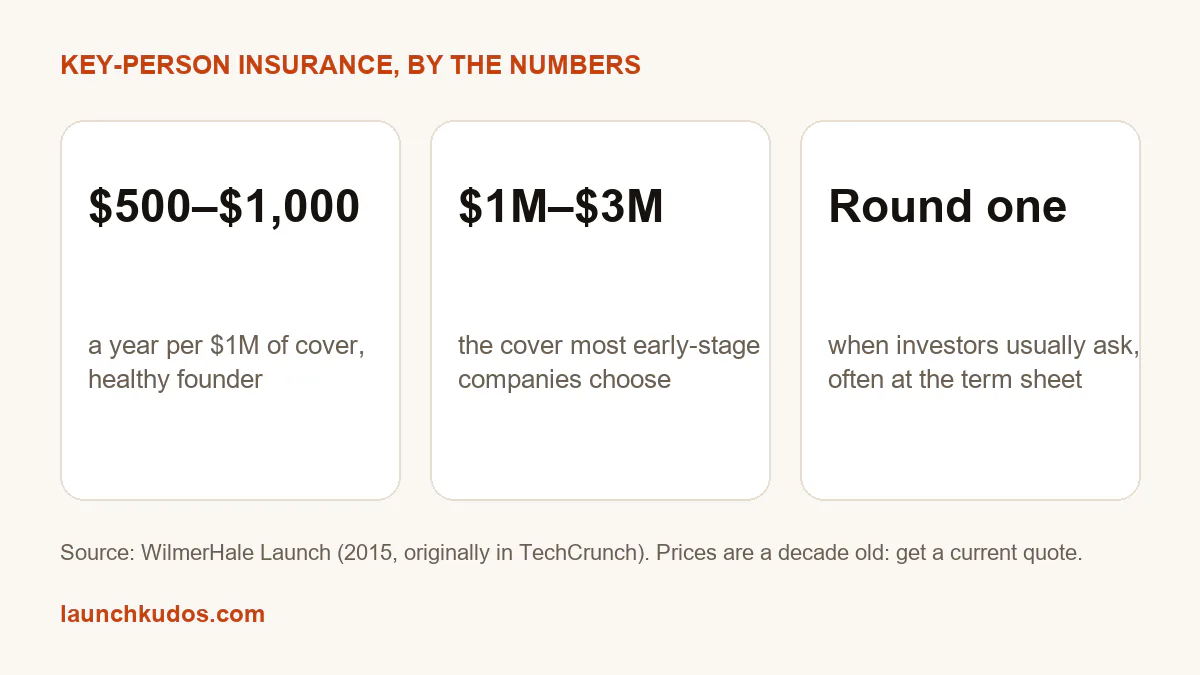
WilmerHale describes it as "basically term life insurance on a company's founder or founders, with the company as the beneficiary." The payout covers wind-down costs, or buys time to find a replacement. Their figures:
- Cost: around $500 to $1,000 a year per million dollars of coverage, for a healthy person.
- Size: most early-stage companies buy $1 million to $3 million.
- Medical: a physical exam is required.
- Review: the board decides each year whether to keep the policy.
Those numbers are from a 2015 article. Treat them as a starting point and get a current quote.
Our take: insurance pays out if a founder dies or can't work. It does nothing when the problem is a resignation, a scandal or a falling-out between founders, and those are the cases that hurt startups most often. Buy the policy if an investor asks for it. Don't count it as your plan.
Lowering the bus factor in a small AI team
The "bus factor" is how many people could disappear before the project stalls. At most seed-stage AI companies it's 1. Here's what raises it, roughly in order of cost:
Access: an afternoon's work
- Put two named humans on every critical account: cloud, GitHub org, domain registrar, DNS, payments, the model API provider, app stores.
- Move secrets into a shared vault. Not one founder's laptop, and not one founder's personal password manager.
- Write down who holds 2FA recovery codes for each account.
Documentation: a week, spread out
- A runbook for deploying, rolling back and rotating keys. If only one person can ship a fix at 2 AM, that's the risk.
- Where the model weights, datasets, evaluation sets and fine-tuning configs live, and how to rebuild them.
- A one-page list of the top 10 customers and partners: who the contact is, what was promised, when the contract renews.
Equity and roles: talk to your lawyer
- Founder vesting. The usual setup is a four-year schedule with a one-year cliff, and Stripe Atlas uses the same default. Vesting keeps a departing co-founder from leaving with a full stake.
- A named deputy. For each founder role, name the person who steps in for 30 days, and tell them.
- A short written succession note for the board, even a two-person one. Answer three questions: who decides, who runs things in the meantime, and what gets said publicly.
What to say if it happens
Nvidia's board said on November 17 that it did "not intend to reinstate" Huang, per NBC News. On November 23 it voted unanimously to do exactly that.
Our take: when a key person leaves suddenly, say what is true today and promise only what you control. "Our co-founder has stepped away. Here is who is running engineering, and here is how to reach us" ages well. "They will never return" might not.
A 30-minute key-person audit
- List every account that could stop the company. Does each one have two admins?
- List the three people whose sudden absence would hurt most. Is each role documented?
- Is founder equity vesting? Check the actual documents, not your memory.
- Has an investor asked about key-person insurance? If so, get a current quote.
- Is there a written note on who runs the company for 30 days if a founder can't?
Fix what you can this week. The rest goes on the board agenda.
Read next
- Nvidia reinstates Jensen Huang: what AI founders should watch
- When to launch your AI tool (and when to wait)
This is general information, not legal, insurance or investment advice.
- #key-person-risk
- #founders
- #fundraising
- #governance
- #ai-startups