The lazy story about war and markets goes like this: conflict breaks out, oil and defense stocks rise, everything else falls. November 2026 broke almost every part of it.
Below are five mechanisms that explain what actually happened. Each comes with a dated example and a source. This is education, not investment advice.
1. Oil carries a risk premium, and it drains out as fear fades
The war with Iran disrupted tanker traffic through the Strait of Hormuz earlier this year. By November 20, Brent had settled at $92.57 and WTI at $83.98, the third weekly decline in a row, CNBC reported. The same report says crude flows through Hormuz were back to roughly pre-war levels, even though attacks on tankers were still running at about one a day.
The IEA still calls the conflict the biggest disruption ever to global oil and gas trade. BNP Paribas's Aldo Spanjer told CNBC that current prices are only right "if you believe that this geopolitical risk doesn't come back."
The lesson: markets price the expected flow of oil, not the headline. Once the barrels move again, the premium leaves, even while the shooting continues.
For tech: cheaper oil lowers costs for chip fabs and data centers in energy-importing countries. It's a small tailwind, and it can reverse quickly. OPEC+ meets on November 29.
2. Defense stocks follow budgets, not explosions
On April 28, after the war started, the ITA defense ETF was down about 12% from early March while the S&P 500 was up 3.5%, according to CNBC. Bank of America's Ronald Epstein summed up the dynamic: peace is "good for humanity, but not great for defense."
Then, on November 4, Democrats won both houses of Congress in the midterms. Europe's aerospace and defense index fell about 0.7% that day while the STOXX 600 rose 0.9%, and BAE Systems lost about 4%, Yahoo Finance reported. The reasons given were expected scrutiny of military spending and contracts that Congress hasn't funded yet.
The lesson: a war that is already priced in, plus doubt about who pays for the weapons, can push defense stocks down.
3. Export rules change a chip company's market overnight
On November 16, the US barred advanced US chips from foreign data centers that serve Chinese customers remotely. Jefferies estimated the rule could cut $44–62 billion from Nvidia's data-center revenue next year, TechCrunch reported. The next day, acting CEO Colette Kress said Nvidia would stop selling H200 chips in China.
China's foreign ministry said Beijing "has consistently opposed the abuse of export control measures," per CBS News.
Then politics took over. Nvidia closed at $125.53 on November 20 and $165.05 on November 23, the day the board reinstated Jensen Huang. On November 24 it gave back 5.9%, closing at $155.38. Reuters describes a renewed fight in Washington over China's access to chips, with several bills now moving through Congress.


I have warned the administration from the start about Communist China obtaining our most advanced chips through both smuggling and remote access. The controversy with Nvidia and Megaspeed is just the tip of the iceberg, and it’s not resolved because Jensen Huang has his job back. Show more
The lesson: for chipmakers, a rule about who may buy matters more than a war about where the chips are made.
4. Concentration turns one stock's fall into a market's fall
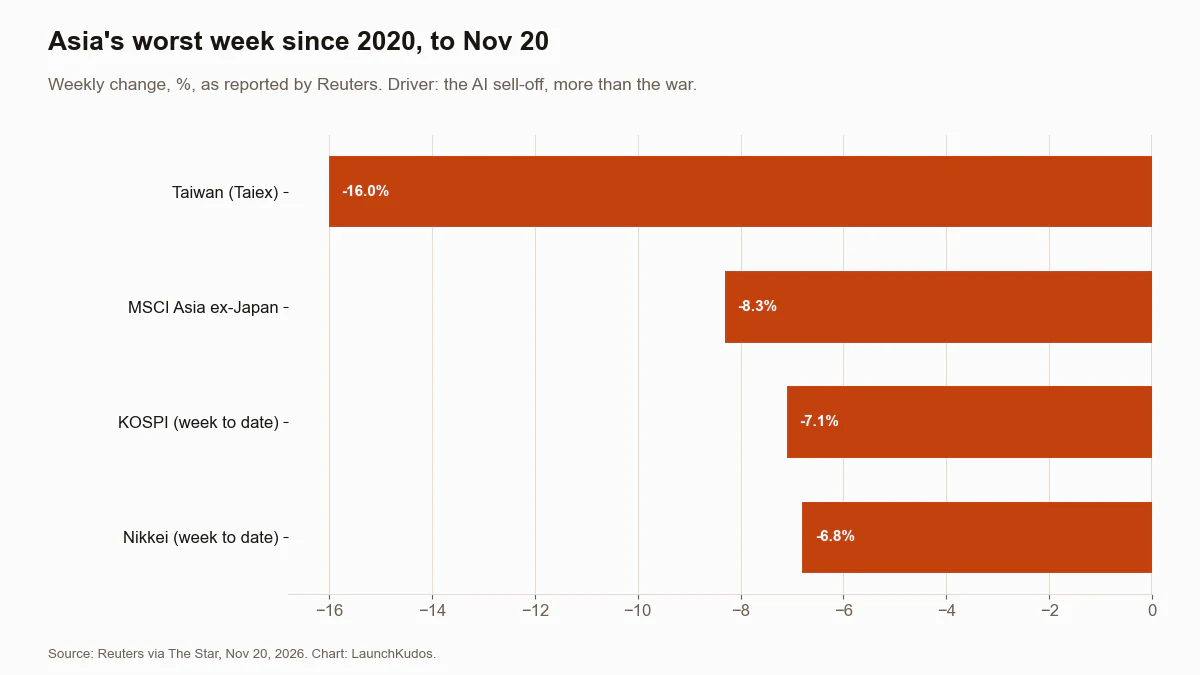
In the week to November 20, Taiwan's market fell 16%, its worst week since 1991. Korea's KOSPI was heading for a 7.1% weekly drop, Reuters reported via The Star. Reuters blamed the AI sell-off, Huang's exit and expectations of a Fed rate hike. The war in the Gulf was a minor factor.
On November 21 the Taiex fell another 6.23%. TSMC closed at NT$2,000, down 22.78% from its October 6 high, Focus Taiwan reported. Taiwan authorized its NT$500 billion stabilization fund to step in and restricted short selling.
The lesson: when one company is a large share of an index, its news is the index's news. TSMC is that company in Taiwan.
5. In a risk-off week, money runs to the dollar and rotates to cheaper winners
The same Reuters report put the dollar index at 103.86, its highest since April 2025, and the US 10-year yield at 5.02%.
Some of the money leaving Taiwan and Korea went to India, which imports oil and so benefits when crude falls. Foreign investors had put ₹84,166 crore into Indian stocks in November by the 17th, PTI reported. Geojit's V K Vijayakumar called the AI unwind "a blessing in disguise for India."
What it means if you build in AI
These are our opinions:
- Your compute is now a policy question. Ask where your GPUs physically sit and who your provider sells to. The November rules target exactly that.
- "AI stock sell-off" is not "AI demand collapse." The week's moves were driven by positioning, rates and one CEO's job. None of the coverage above reports customers cancelling AI budgets.
- Launch timing again. Weeks like this bury product news. Here is how to pick a launch date.
What we couldn't verify
- The size of TSMC's and the Taiex's November 24 rebound. Only secondary sites reported it.
- Year-to-date returns for defense stocks. We found no reliable figure.
- Exact late-November closes for the Sensex and Nifty. Sources conflict.
Prices are official closes. Nothing here is a recommendation to buy or sell anything.
Read next
- #geopolitics
- #semiconductors
- #defense-stocks
- #ai-chips