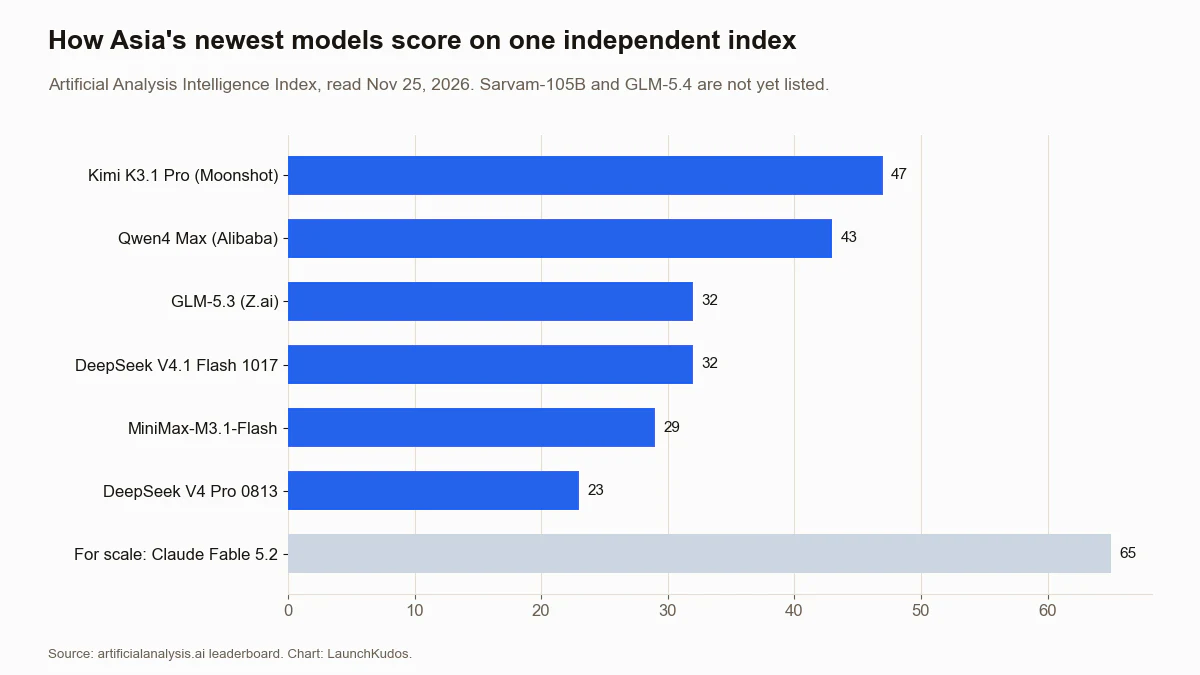
 Artificial Analysis Intelligence Index, read Nov 25, 2026 (leaderboard). One independent source; benchmark claims elsewhere in this article are the companies' own.
Two years ago the question was whether Asian labs could keep up. Now they ship almost monthly, and several give away weights that US labs keep closed. The catch is in the licences, the benchmarks and the politics. Here's each lab's newest model, its best feature and its biggest catch.
India: Sarvam-105B goes fully open
On Nov 22, Sarvam released Sarvam-105B-1711, per its blog:
- Size: a 105-billion-parameter mixture-of-experts model with about 10 billion active parameters.
- Licence: Apache-2.0, which allows commercial use with no strings.
- Price: listed at ₹10 per million input tokens and ₹25 per million output on Sarvam's Token Factory.
- Company's claims: a jump from 42.6 to 73.9 on an average of eight agent benchmarks.
The weights are on Hugging Face. Sarvam was picked in April 2025 under the government's IndiaAI Mission to build India's sovereign large language model.
China: Z.ai's GLM-5.4 and the GLM-5.3 family
GLM-5.4 (Nov 23) is available only to subscribers of Z.ai's coding plan. The company calls it its "first Loop Transformer," and says weights will come later, after safety review.

Introducing GLM-5.4: Generalized Coding with Our First Loop Transformer. - Loops existing layers in the GLM-5 base model for deeper reasoning - Pushes beyond traditional coding to video, games, 3D shaders, and CAD modeling - Adds vision capabilities for stronger visual coding Show more
The newest open GLM is GLM-5.3, about 753B parameters. It ships under a custom licence: MIT-style, except that services with more than $10 billion in revenue need a Z.ai security review (Hugging Face). US government testers (CAISI) called it "the most cyber-capable open-weight model released to date," but still about four months behind the US frontier (NIST).
China: DeepSeek's cheap Flash model and its agent harness
DeepSeek-V4.1-Flash-1017 (Oct 17) is MIT-licensed. The API charges $0.30 per million input tokens and $1.20 per million output, and half that off-peak, per DeepSeek. DeepSeek's own card doesn't give a parameter count.
The company also ships DeepSeek Harness, an MIT-licensed agent app in public preview. A separate dsh-superagent-prototype repo has 24,559 stars, but its README says it's a research prototype, not an official product.
China: Alibaba's Qwen4-Max goes closed
Qwen4-Max (generally available Nov 16) has about 2.4 trillion parameters with about 71 billion active, a 1M-token context window, and built-in vision, per Alibaba. It scores 43 on the Artificial Analysis index. But it's API-only. Alibaba says smaller open Qwen4 models are coming "soon."

📢 Meet Qwen4-Max, your new AI teammate for work, creativity, and discovery! Qwen4-Max is built on a new MoE architecture with native vision and a 1M-token context window. Highlights: - Outperforms Qwen3.8-Max with up to ~50% fewer tokens, while average cost per task drops over Show more

China: Kimi K3.1 Pro, the top score with a catch
Kimi K3.1 Pro (announced Oct 23, weights Nov 4) is a 2.8-trillion-parameter mixture-of-experts model with about 104 billion active parameters and a 1M-token context window. Its score of 47 on Artificial Analysis is the highest of any Asian model listed. But the same source calls it "somewhat verbose" and measured 155.6 seconds to the first answer token (Artificial Analysis).
Its licence requires businesses with more than 100 million monthly users or $20 million in monthly revenue to display "Kimi K3.1-Pro."

Introducing Kimi K3.1 Pro: our most capable 3T-class open-weight model. 🔹 1M-token context, 2.8T total / 104B active params (MoE), Multimodal. 🔹 Full-project coding: games in Unreal, Unity & Godot. 🔹 Excels at parametric 3D modeling in Blender & CAD. 🔹 More reliable at Show more

China: MiniMax's cheap model for non-commercial use
MiniMax-M3.1-Flash (Oct 19) has about 428 billion parameters, a 1M-token context window, and costs $0.15 per million input tokens and $0.60 output (MiniMax). But its licence is non-commercial by default, and commercial use needs attribution, plus written approval above $20 million in yearly revenue (Hugging Face).
Which one should a startup use?
| Model | Licence | Best for | Watch out for |
|---|---|---|---|
| Sarvam-105B-1711 | Apache-2.0 | Indian languages, self-hosting | Context length unclear |
| GLM-5.3 | Custom, MIT-style | Coding and agents | Security review above $10B revenue |
| DeepSeek V4.1 Flash | MIT | Cheap API at scale | Censorship findings, lab-vs-independent score gap |
| Qwen4-Max | Closed (API) | Strong all-rounder | No weights |
| Kimi K3.1 Pro | Custom | Hardest reasoning tasks | Slow, branding clause at scale |
| MiniMax M3.1-Flash | Non-commercial by default | Low-cost experiments | Commercial licence terms |
Our take: for a product, the licence matters more than one benchmark point. Read it before you ship. If you sell to US government or regulated customers, check where your model comes from. Cursor learned that the hard way.
Reader poll
Would you ship a product on a Chinese open-weights model?
Vote to see results.
FAQ
What is Sarvam AI's newest model?
Sarvam-105B-1711, released Nov 22, 2026. It's a 105B mixture-of-experts model under Apache-2.0, with weights on Hugging Face.
What is GLM-5.4?
Z.ai's newest model, released Nov 23, 2026, to subscribers of its coding plan only. Z.ai calls it its first "Loop Transformer" and hasn't released weights or a model card yet.
Is DeepSeek open source?
DeepSeek publishes its model weights under the MIT licence, for example V4.1-Flash-1017. Its training data and full training code aren't public.
Which Asian model scores highest?
On the Artificial Analysis Intelligence Index (read Nov 25, 2026), Kimi K3.1 Pro scores 47, the highest of the Asian models listed. Claude Fable 5.2 leads overall with 65.
Related: Inside the US AI labs' pipeline · Trending GitHub repos · Asia's markets in November
- #open-weights
- #llm
- #china-ai
- #india-ai