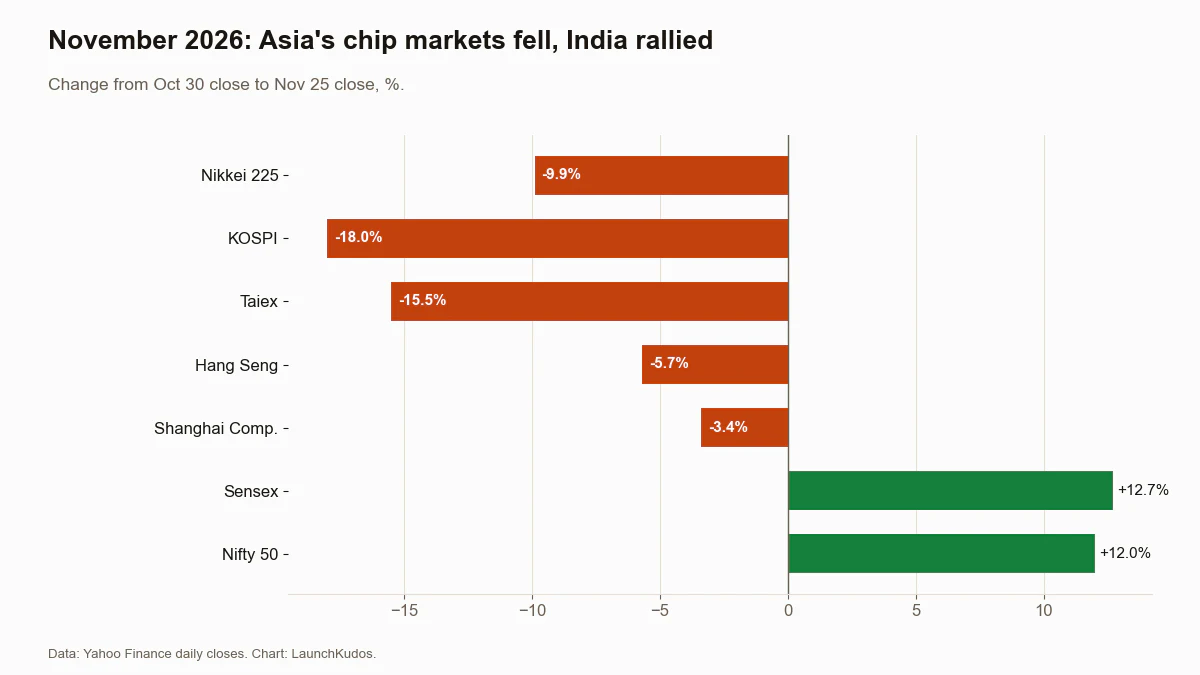
 Change from the Oct 30 close to the Nov 25 close. Data: Yahoo Finance daily closes.
Asia makes most of the hardware behind the AI boom: TSMC's chips, SK hynix's and Samsung's memory, and Advantest's and Tokyo Electron's equipment. In November that concentration worked in reverse. When Nvidia's CEO resigned and the market began questioning AI spending, the selling went straight down the supply chain.
Here's what happened in each market, with a bull and a bear view for each. This is education, not investment advice.
How the AI chip supply chain connects these markets
Nvidia designs the GPU. TSMC in Taiwan manufactures it and packages it next to stacks of high-bandwidth memory (HBM) using its CoWoS process. The HBM comes from SK hynix and Samsung in Korea. Japan's Advantest tests the chips, and Tokyo Electron makes the equipment used to build them. So when investors sold Nvidia's story, they sold all of these with it. Samsung and SK hynix alone are more than 40% of the KOSPI, per CNBC.
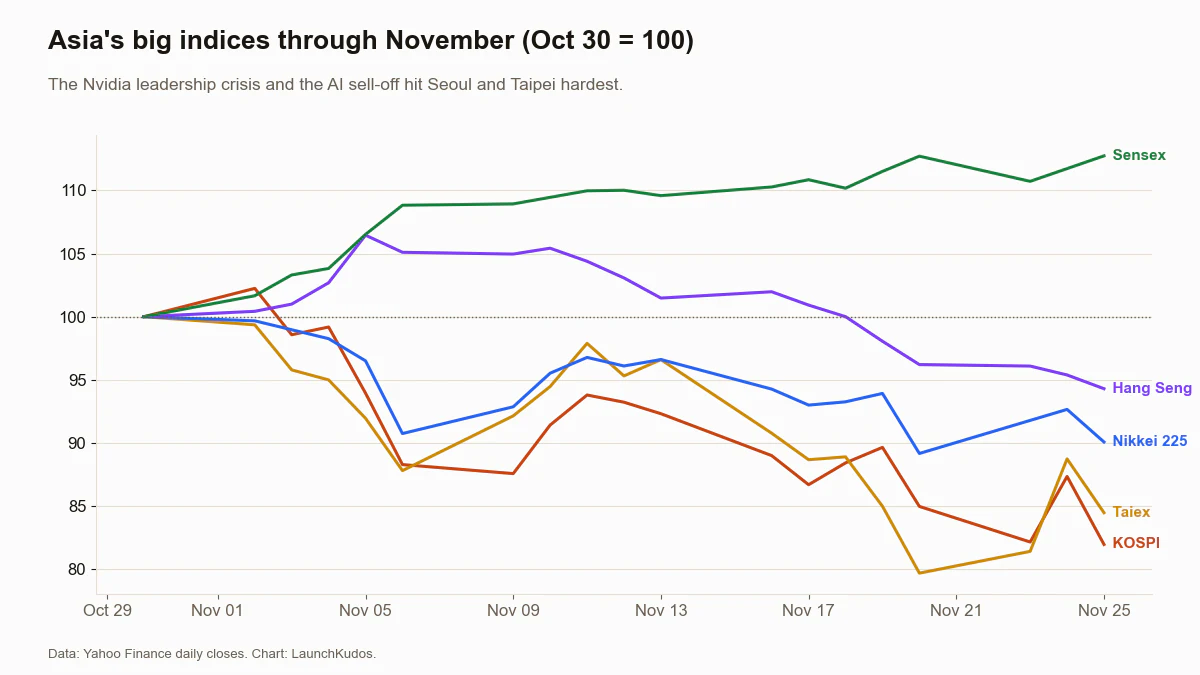 Indexed to Oct 30 = 100. Data: Yahoo Finance daily closes.
South Korea: −18% and a record of trading halts
On Nov 25 the KOSPI fell 6.16% to 4,697.51. Samsung dropped 9.87% and SK hynix 11.05%, and it was the market's 62nd "sidecar" trading pause of the year, per Korea JoongAng Daily.
The fundamentals tell a different story. In late October, SK hynix reported third-quarter operating profit of ₩83.33 trillion, beating forecasts. It said long-term deals with 14 customers cover more than half of its 2027–28 capacity, per CNBC.
Taiwan: the worst week since 1990
The Taiex lost 17.5% in the week to Nov 20, and regulators restricted short selling. Foreign investors pulled about $10 billion in early November after about $28 billion left in October, per bne IntelliNews.
On Nov 24, the day after Huang's reinstatement, TSMC, Foxconn and MediaTek all rose nearly 10%. They fell again the next day.
TSMC's October revenue was still a record NT$586.89 billion, up 59.7% year on year. Separately, Reuters reported, citing sources, that TSMC told Chinese chip designers to stop ordering 16nm-and-below chips without a US licence. TSMC hasn't confirmed this.
Japan: SoftBank's AI bet bites
SoftBank reported a fiscal second-quarter net loss of ¥1.12 trillion, including a ¥597.2 billion hit tied to changed power-equipment plans for US AI data centers, per CNBC. Its shares fell about 40% in November. Advantest fell about 32% and Tokyo Electron about 18%.
Sony was the exception. It rose after a 44% jump in quarterly profit, per MarketScreener.
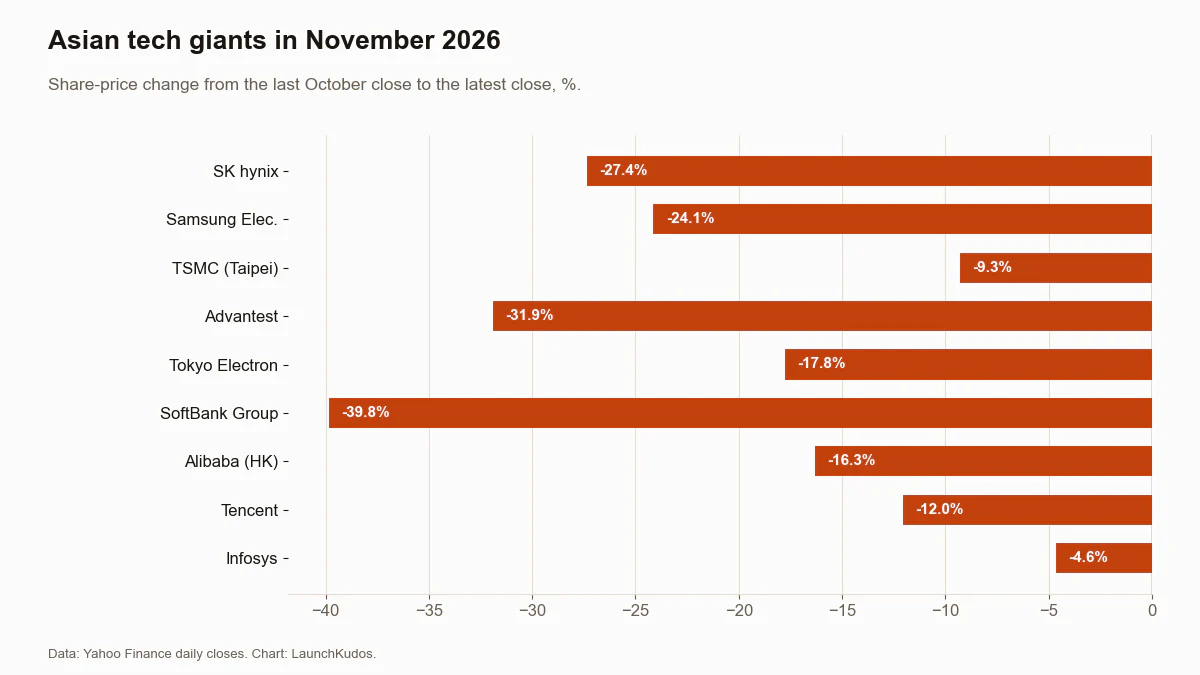 From the last October close to the latest close. Data: Yahoo Finance.
China and Hong Kong: cloud growth, cash burn
Alibaba's cloud revenue rose 53% to RMB60.97 billion, but free cash flow was negative RMB34.47 billion as AI spending rose about 60%. Nikkei Asia reports it is training its next model on its own T-Head chips as US chip access tightens (Nikkei Asia). The Hang Seng hit a half-year low on Nov 25.
India: the rotation winner
The Sensex rose 1.82% on Nov 25 alone, to 83,938.28. Religare put November foreign inflows above $14 billion, per Bombay Samachar. India gains twice from this mix: it has little AI-hardware exposure, and it benefits from cheaper oil.
What it means if you build in AI
Our take: November looked like a crash in AI's supply chain, but the reported order books, TSMC's and SK hynix's, show no weakness. What changed was the price investors will pay for the story. For a startup that rents compute, the practical risks are export rules and Nvidia's leadership, not a sudden GPU glut. We covered both in the Nvidia story and in how ASML's machines sit under all of it.
Reader poll
Is November's chip sell-off a buying opportunity or the start of an AI bust?
Vote to see results.
FAQ
Why did Asian chip stocks fall in November 2026?
Mostly because of Nvidia: its CEO resigned on Nov 12 and was reinstated on Nov 23. New US export rules and doubts about AI spending added to it. Korean and Taiwanese indices are dominated by chip companies, so they fell the most.
Why did India's market rise?
Foreign investors moved money out of crowded AI and chip trades and into India, which has little AI-hardware exposure and benefits from lower oil prices. Religare put November foreign inflows above $14 billion.
What is HBM?
High-bandwidth memory: stacked memory chips placed right next to an AI GPU. SK hynix and Samsung are the main suppliers. TSMC packages HBM alongside Nvidia's GPUs.
Related: ASML explained · Asia's newest AI models · War, oil and chip controls
- #asia-markets
- #semiconductors
- #ai-supply-chain
- #hbm