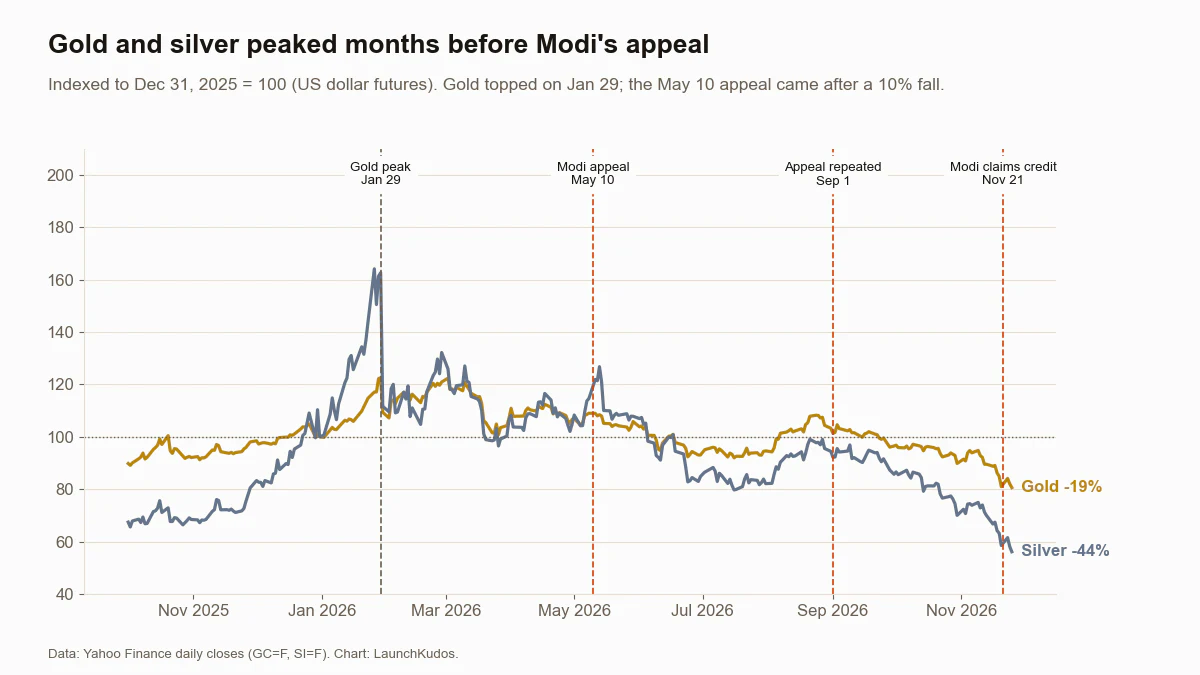
 US dollar futures, indexed. Data: Yahoo Finance daily closes (GC=F, SI=F).
When a prime minister says his words moved a global market, it's worth checking. Here's what was said, what happened to gold, silver and oil, and what the evidence says about cause and effect.
What exactly did Modi say?
May 10, 2026, Hyderabad. At a Telangana BJP rally, with Brent crude above $100 and India's forex reserves down nearly $38 billion since February, Modi made a list of savings appeals: less fuel and edible oil, the metro over the car, no foreign trips or destination weddings, and no gold. PTI reported he "called for postponing the purchase of gold and foreign travel for one year" (PTI via NewsDrum). Bloomberg's translation: "For a year, be it any function, we shouldn't buy gold jewellery" (via Newslaundry).
In the current situation, we must place great emphasis on saving foreign exchange.
Three days later, on May 13, the government raised the import duty on gold and silver from 6% to 15%.
November 21, 2026, Lucknow. At a skills convocation, Modi credited the public's response:

The Week's translation adds: "the countrymen bought less gold, and gold prices fell" (The Week). The appeal was six months earlier, not "a year ago," as The Federal pointed out.
Note: we found no official transcript on PIB or pmindia.gov.in for either speech. All quotes above are news-agency translations, and they differ slightly between outlets.
Did the appeal move gold prices?
The timeline says no
Gold hit its record of $5,318 an ounce on January 29. By May 8, the last trading day before the appeal, it was already about 10% lower. A fall that began three months before the speech can't have been caused by it. And the fall was global: dollar-priced gold fell in every market, not just India.
The dollar and the Fed did more
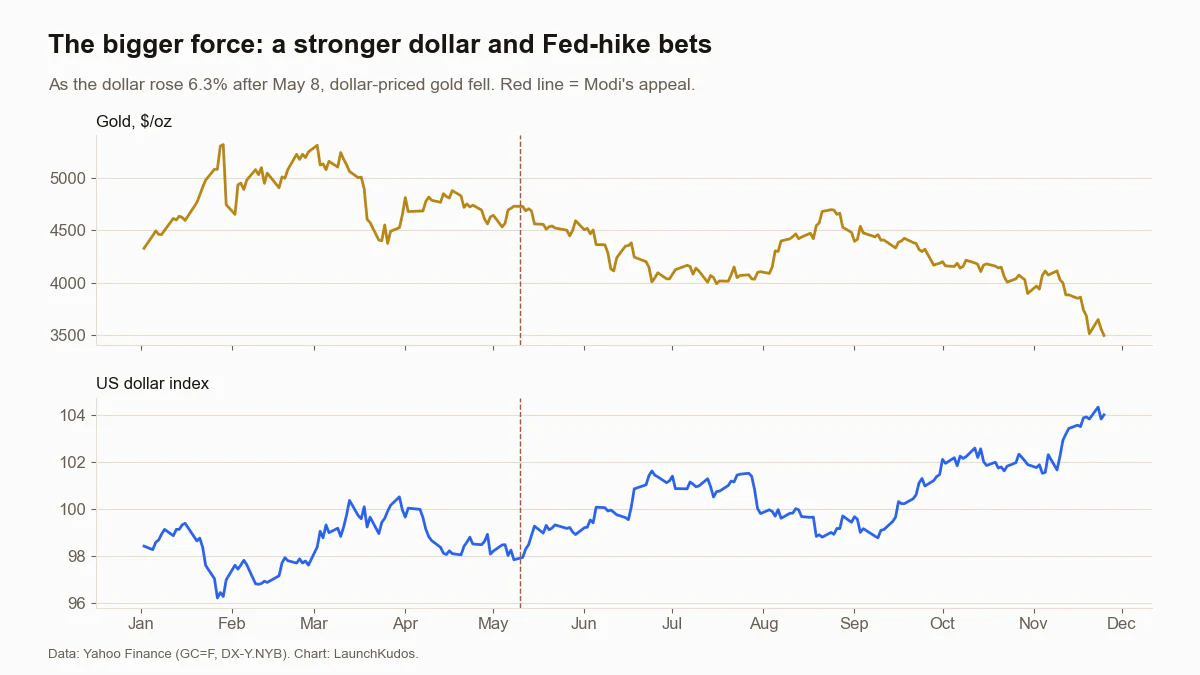 Data: Yahoo Finance (GC=F, DX-Y.NYB).
Since May 8:
- The dollar index is up 6.3%. Gold is priced in dollars, so a stronger dollar pushes it down.
- Rates: markets now price a December Fed rate hike at 96–98% odds. Higher rates make gold, which pays no interest, less attractive.
- Fund outflows: gold ETFs lost 20.4 tonnes in the week to Nov 20, the most since June. Some investors sold gold to cover margin calls during the AI-stock sell-off (FXStreet, citing World Gold Council data).
FxPro's Alexander Kuptsikevich names Fed hikes and fading AI enthusiasm as the main drivers. Central-bank buying, 321 tonnes in Q3 per the World Gold Council, has been the main support.
What India's buying did change
The appeal and the duty hike did show up in India's own numbers. The World Gold Council's Q3 report:
| India, Q3 2026 | Tonnes | Change vs a year earlier |
|---|---|---|
| Total demand | 162 | −29% |
| Jewellery | 100 | −20% (weakest Q3 since 2020) |
| Bars and coins | 55 | −40% |
| Official imports | 64 | −70% |
| Unofficial (smuggled) inflows | ~50 | up from ~3 |
The last line matters. The WGC links the jump in smuggling to the duty hike, so some of the "drop in buying" is gold coming in off the books. The WGC report doesn't mention the PM's appeal at all. Commerce Secretary Rajesh Agrawal credits the duty, not the appeal, for lower imports.
Why Indians felt a smaller fall
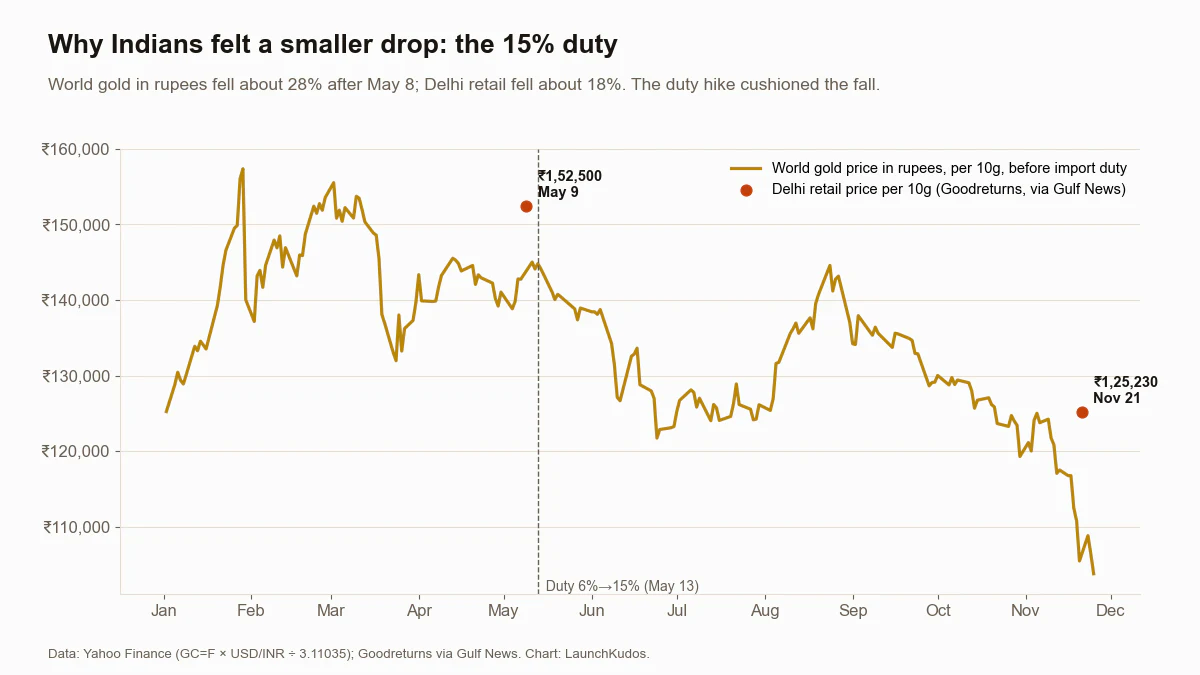 World gold in rupees = gold futures × USD/INR ÷ 3.11035 (troy ounce to 10 g), before duty and GST. Retail prices: Goodreturns via Gulf News.
In rupees, world gold fell about 28% after May 8, but the Delhi retail price fell only about 18%, from ₹15,250 to ₹12,523 a gram. The gap is mostly the extra 9 percentage points of import duty. So Indian buyers missed part of the fall that the rest of the world got.
Our verdict: Modi's appeal is a real event with real effects on India's imports, but there's no evidence it caused the global fall in gold. If anything, the duty that came with it meant Indians paid more than the world did.
Silver: −51% since May
Silver peaked at $115.08 on January 26 and is down about 66% from that peak and 51% since the appeal. Silver is half precious metal, half industrial metal. Its fall tracks the AI and industrial sell-off and a stronger dollar more than anything India did.
Crude oil: war spikes, then a glut
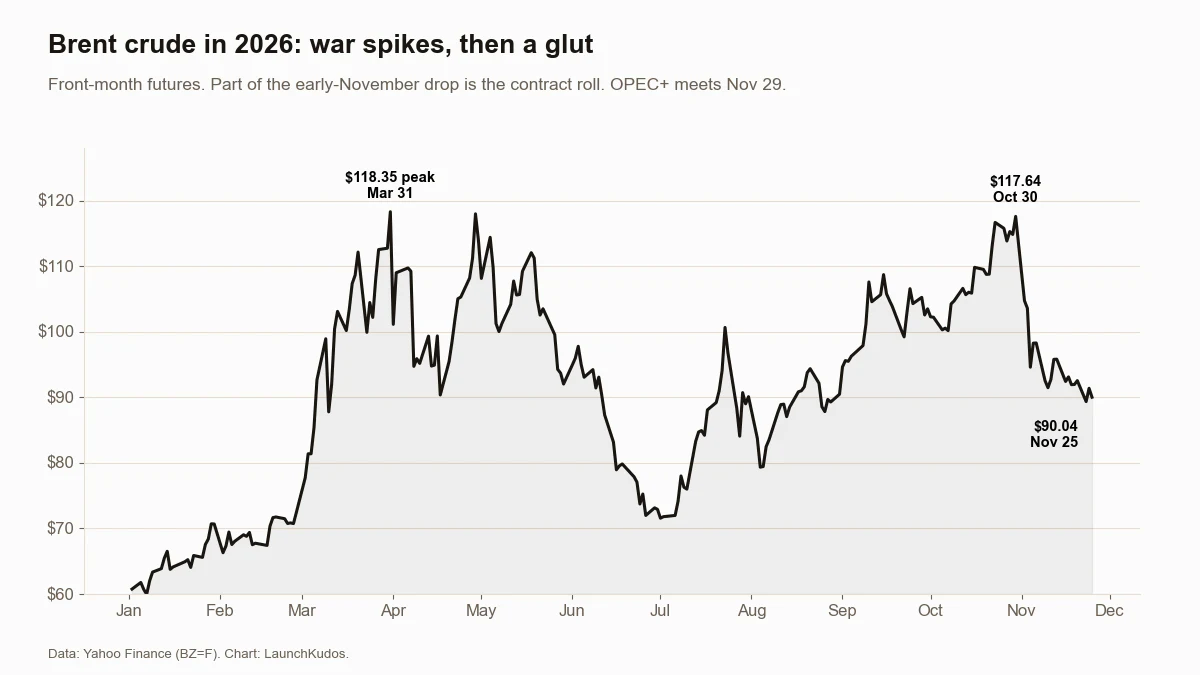 Front-month Brent futures (BZ=F). Part of the early-November drop is the contract roll. Data: Yahoo Finance.
Brent rose from $100 on Oct 5 to $117.64 on Oct 30, on Iranian attacks on ships in the Strait of Hormuz, Houthi strikes on Saudi infrastructure, and Ukrainian drone strikes on Russian refineries. It then fell back to about $90. Hormuz traffic recovered, OPEC+ raised output, and the IEA switched its Q4 view from a shortage of 1.8 million barrels a day to a glut of 1.7 million (Wallstreetcn via Longbridge). OPEC+ meets on Nov 29 to set 2027 quotas.
The forex math nobody mentions
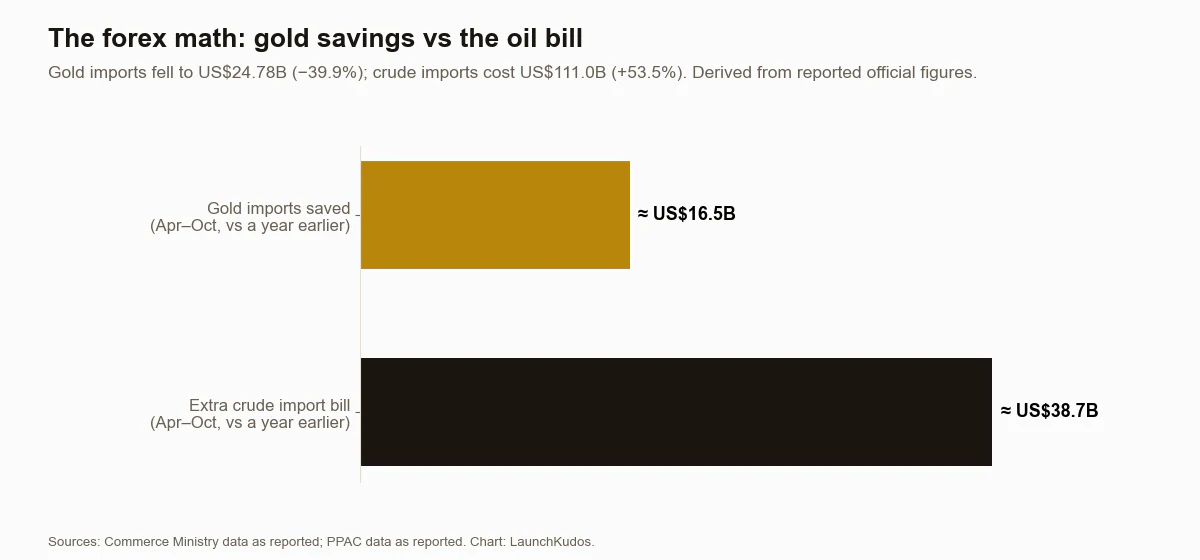 Derived from reported official figures: gold imports of $24.78B, down 39.9% (Commerce Ministry data, as reported); crude imports of $111.0B, up 53.5% (PPAC data, as reported).
The appeal's stated goal was saving foreign exchange. On that measure, the roughly $16.5 billion saved on gold in April–October is less than half the roughly $38.7 billion extra spent on oil. The appeal also asked people to use less fuel, and oil is where the money went. Gold was the smaller lever.
Reader poll
Did Modi's appeal bring gold prices down?
Vote to see results.
FAQ
Did Narendra Modi ask people to stop buying gold?
Yes. On May 10, 2026, at a rally in Hyderabad, he asked Indians to postpone buying gold for a year to save foreign exchange during the Iran war. He repeated it on Sep 1 and credited it with the price fall on Nov 21.
Why did gold prices fall in 2026?
Gold peaked on Jan 29 at $5,318 an ounce. It fell mainly because of a stronger US dollar, bets on a Fed rate hike, outflows from gold ETFs, and margin-call selling during the AI-stock sell-off. Indian demand fell too, but that shows up in imports, not the world price.
Why didn't Indian gold prices fall as much?
Because India raised the import duty on gold from 6% to 15% on May 13, 2026. World gold in rupees fell about 28% from May 8 to Nov 25, but Delhi retail prices fell about 18% over roughly the same period.
What happened to silver?
Silver fell about 51% from May 8 to Nov 25, and about 66% from its Jan 26 peak of $115.08, as industrial and AI-linked selling and a stronger dollar hit it.
Related: Reliance: news vs stock in 2026 · Is AI a bubble? · Asia's markets in November
- #gold
- #india-economy
- #commodities
- #fact-check