"Bubble" is the most overused word in markets, so we tried to test it instead. We gathered the numbers on spending, revenue, valuations, funding and the deals that link them, then lined up the strongest arguments on each side.
How much is Big Tech spending on AI?
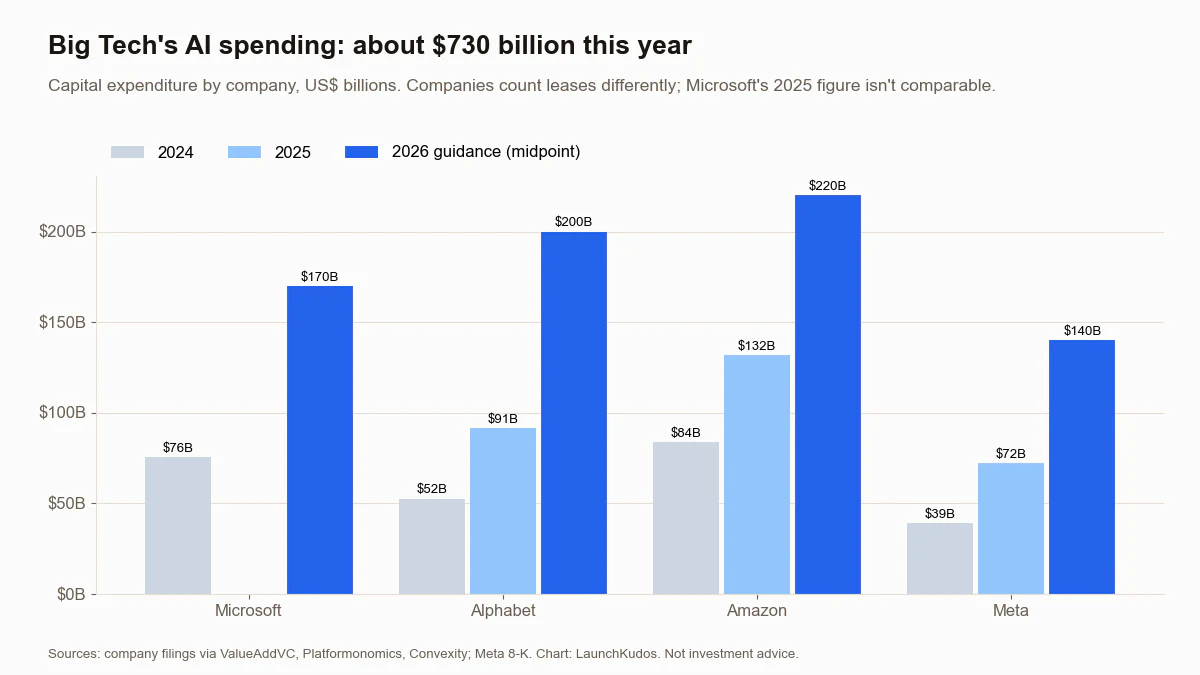 Company filings and guidance via ValueAddVC, Platformonomics, Convexity and Meta's 8-K. 2026 is the midpoint of guidance.
The four biggest US tech companies roughly tripled their capital spending in two years. Oracle adds $90–95 billion in its 2027 fiscal year (ERP Today). The IEA expects about $4 trillion of data-center investment worldwide by 2030 (via EnergyConnects).
The strain is starting to show in cash flow. In Q3 2026 Meta's free cash flow was negative ($34.9B of capex vs $32.8B of operating cash flow), Oracle burned $5.4B and carries $125B of debt, and Amazon's trailing 12-month free cash flow was −$42.4B (Yahoo Finance).
Is anyone earning money from AI?
Yes, and fast. But not yet at the scale of the spending.
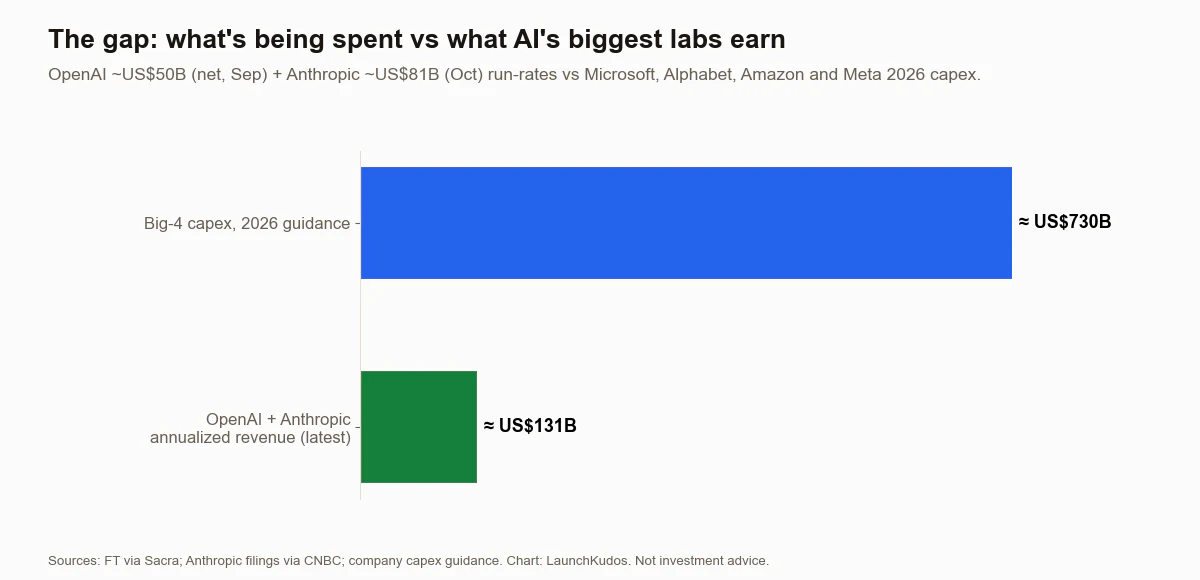 OpenAI about $50B annualized, net basis, at end-September (FT via Sacra); Anthropic about $81B at end-October (CNBC).
Anthropic's revenue for the first nine months of 2026 was $33.2 billion, up about 1,200%. It also reported a nine-month net loss of $104 billion, mostly from fair-value changes on notes and derivatives rather than operations; its operating loss was $1.26 billion. The FT reports OpenAI projects about $278 billion of cumulative negative free cash flow over 2026–30. Bain estimated in 2025 that AI needs $2 trillion a year in revenue by 2030 to justify the buildout, and that the industry was on track to fall $800 billion short (Bain).
Is the AI money going around in circles?
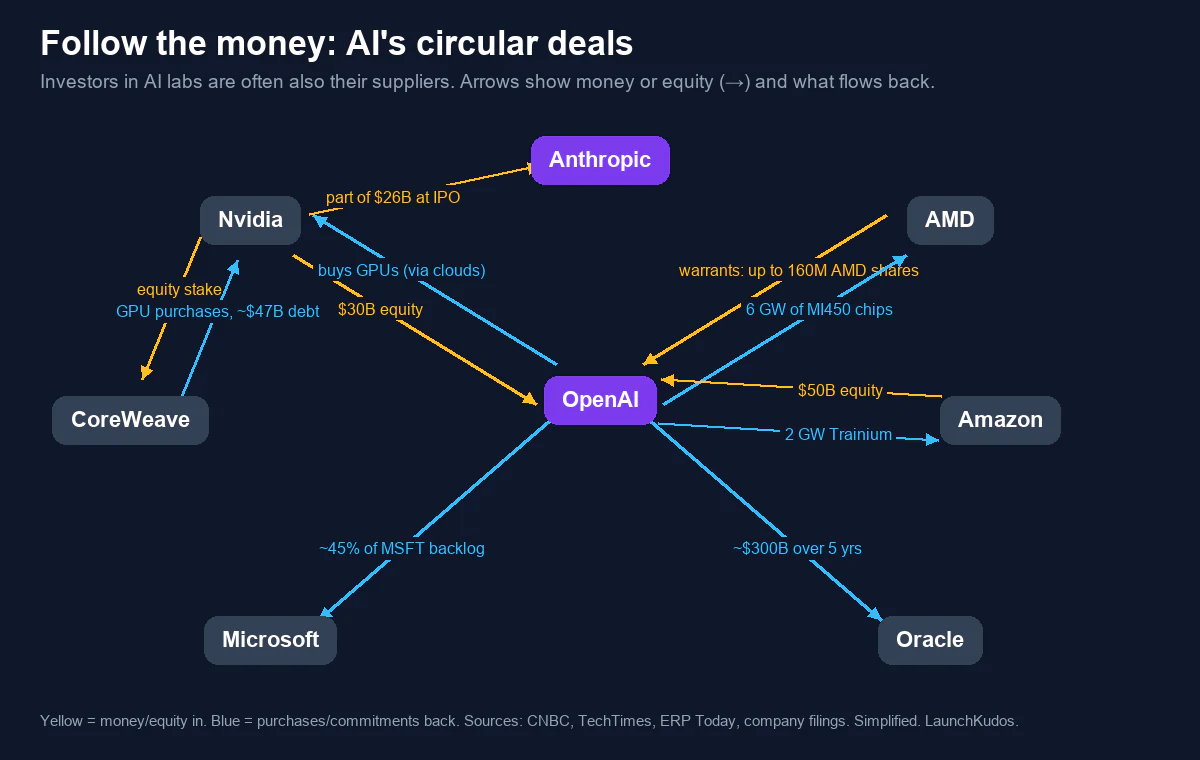 Simplified. Sources: TechTimes, ERP Today, CNBC, company filings.
This is the strongest part of the bear case. Several of the biggest "customers" of AI hardware are funded by the companies selling it:
- Nvidia → OpenAI: a $30 billion equity investment. OpenAI then buys Nvidia chips through Microsoft, Oracle and CoreWeave. An earlier $100 billion letter of intent was never finalized; Huang said it was "probably not in the cards."
- AMD → OpenAI: warrants for up to 160 million AMD shares, while OpenAI commits to 6 GW of AMD chips.
- Amazon → OpenAI: $50 billion of equity, alongside a 2 GW Trainium commitment.
- OpenAI → Oracle: about $300 billion over five years from 2027, roughly half of Oracle's $664 billion backlog. Oracle is funding it with debt and share sales, and S&P rates it BBB−, one notch above junk.
- Meta's Hyperion data center: financed through a $27.3 billion bond issued by a separate vehicle, 80% owned by Blue Owl, which keeps the debt off Meta's balance sheet (Bisnow).
The IMF warned in October that "$1.4 trillion in future revenue" depends on deals between hyperscalers and AI firms. In its adverse scenario, global GDP ends up 1.1% lower by 2028 (Computing).
We're closer to a '99-type moment than a '97.
How do AI valuations compare with the dot-com bubble?
| Measure | Now | Dot-com peak |
|---|---|---|
| S&P 500 forward P/E | 17.1x (5-yr avg 19.8x) (FactSet) | ~24–25x (commonly cited) |
| Shiller CAPE | ~37–39 (trackers vary) | 44.2, the record |
| Expected S&P 500 earnings growth | +33.7% (2026), +16.4% (2027) per FactSet | — |
| Nvidia forward P/E | ~8–17x (reports vary after the November drop) | Cisco ~100x+ |
| Magnificent 7 share of the S&P 500 | over 35% (IMF) | — |
This is the strongest part of the bull case. In 2000, prices ran far ahead of earnings. In 2026, prices fell while earnings kept rising, so multiples came down. One caution from FactSet: in Q3 the Magnificent 7 grew earnings 27.0%, slower than the other 493 companies (32.6%). That's the first time they've lagged since 2022.
Who's raising money, and at what valuation?
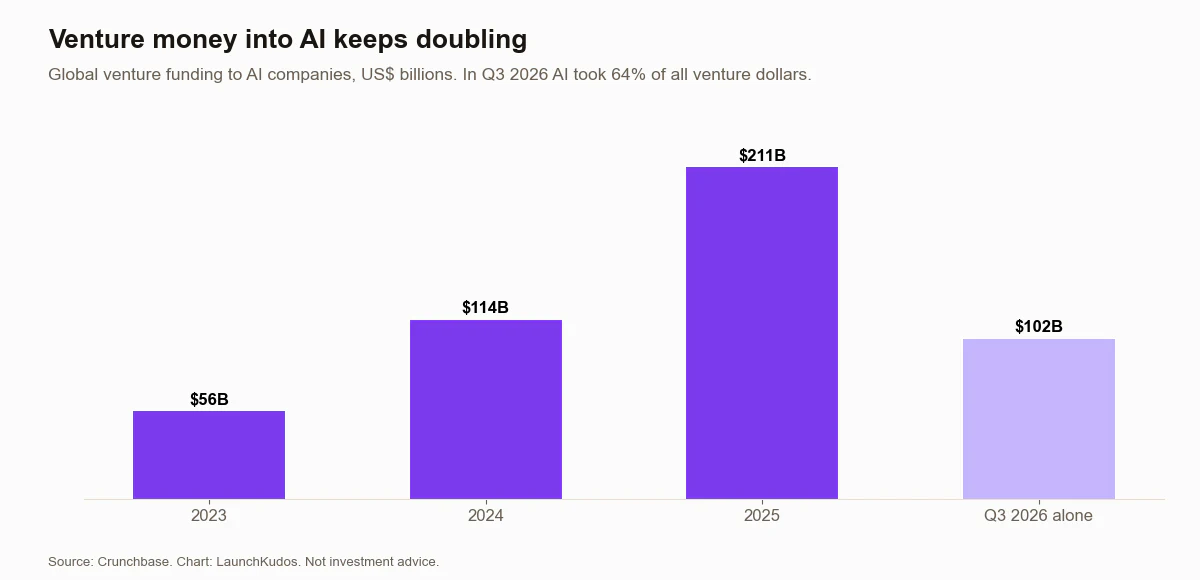 Source: Crunchbase.
- OpenAI: valued at $852 billion in March, now raising up to $20 billion at $1.25 trillion (CNBC).
- Anthropic's IPO: raised $81.3 billion at $83 a share, the largest IPO on record. It fell below its IPO price for the first time on Nov 24, to about $76 (TechCrunch).
- SpaceX: absorbed xAI at $250 billion and Cursor for $60 billion in stock.
The November crack
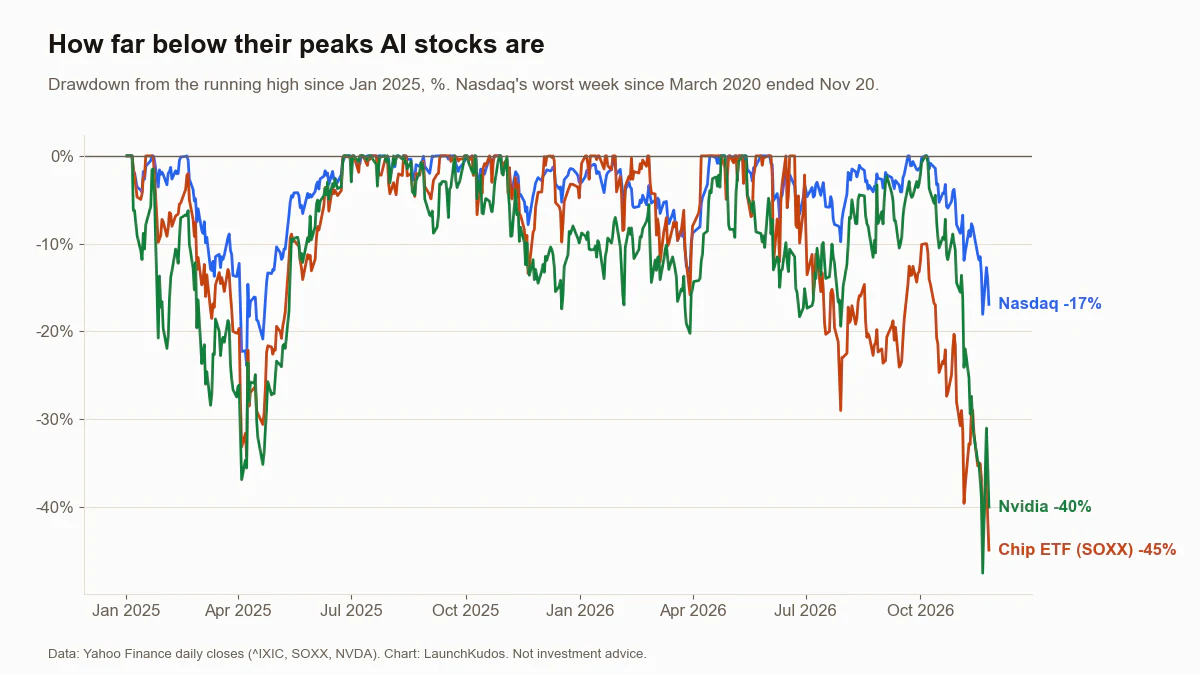 Data: Yahoo Finance daily closes.
In the week to Nov 20, the Nasdaq fell 10%, its worst week since March 2020, and Nvidia fell 22.9%, its worst week since 2008 (NPR). The triggers were Nvidia's CEO exit and a reported SEC probe, Fed-hike bets, and the Anthropic IPO drawing in cash. We trace who actually sold in our Nvidia investigation.

Understating depreciation by extending useful life of assets artificially boosts earnings -one of the more common frauds of the modern era. Massively ramping capex through purchase of Nvidia chips/servers on a 2-3 yr product cycle should not result in the extension of useful Show more


The massive tech sell-off yesterday on fears around the Blue Wave delaying and disrupting the AI data center build out in the US was at a magnitude actually treating tech stocks and especially semis like this mid-term Democratic win will actually end the AI buildout in the Show more
What would settle it? Signals to watch
These would point to a bubble:
- 2027 capex guidance gets cut.
- OpenAI's $1.25T round fails or is downsized.
- Anthropic stays below $83.
- A neocloud or private-credit data-center loan defaults.
- Oracle is downgraded to junk.
- GPU rental prices collapse, or depreciation lives get shortened.
- The SEC finds problems at Nvidia.
These would point to a boom:
- AI revenue keeps compounding monthly.
- 2026's ~34% earnings growth holds into 2027.
- Forward P/Es stay below 20.
- Capex gets funded from cash flow rather than new debt.
Reader poll
Is AI a bubble?
Vote to see results.
FAQ
Is AI a bubble in 2026?
The evidence is mixed. Spending, private valuations and circular, debt-funded deals look like a bubble. Public-market valuations (S&P 500 at about 17x forward earnings) and fast-growing AI revenue look like a boom. Our view is that there are bubble pockets inside a real boom.
How much are tech companies spending on AI in 2026?
Microsoft, Alphabet, Amazon and Meta guide to about $730 billion of capital spending in 2026, much of it on AI infrastructure. Oracle adds $90–95 billion in its 2027 fiscal year.
What are circular AI deals?
Deals where a supplier invests in a customer that then buys the supplier's products. For example, Nvidia invested $30 billion in OpenAI, and AMD gave OpenAI share warrants while OpenAI committed to 6 GW of AMD chips. Critics say this can inflate reported demand.
How does today compare with the dot-com bubble?
The S&P 500's forward P/E (about 17x) is well below dot-com levels, and earnings are growing fast. The Shiller CAPE (about 37–39) is close to the 2000 record of 44.2. Back then, companies like Cisco traded at over 100x earnings.
Related: Who's really selling Nvidia · ASML explained · Inside the AI labs' pipeline
- #ai-bubble
- #nvidia
- #anthropic-ipo
- #big-tech-capex