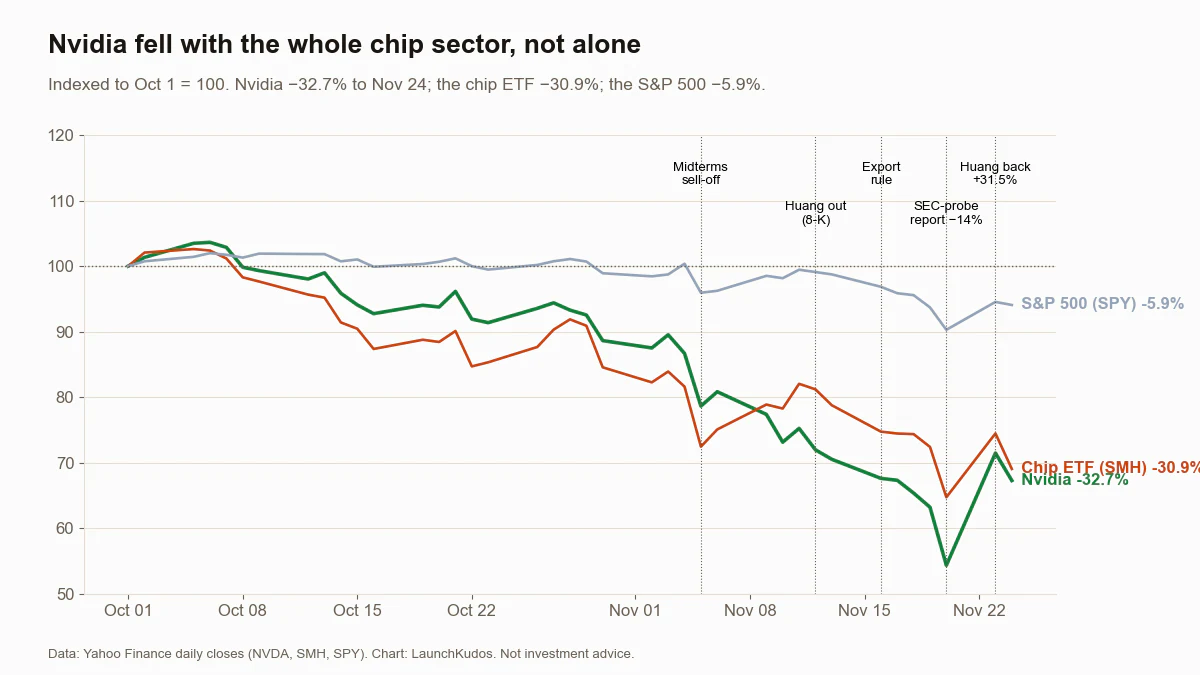
 Indexed to Oct 1 = 100. Data: Yahoo Finance daily closes.
When a $4-trillion-class stock falls by a third in eight weeks, everyone wants a villain: insiders dumping, short sellers attacking, a fund with a grudge. We went through the filings that actually record who sells: insider Form 4s, fund 13Fs and short-interest reports. The answer is less dramatic and more useful.
Were Nvidia insiders selling?
Not much, and not in November.
| Insider | Role | 2026 sales | Notes |
|---|---|---|---|
| Mark A. Stevens | Director | ~6.34M shares, Mar–Sep, ~$1.39B | About $300M on Sep 18 alone (Form 4) |
| Tim Teter | General counsel | 30,000 shares on Nov 19, ~$4.5M | Under a pre-scheduled 10b5-1 plan adopted May 22, about 1% of his holdings (Form 4) |
| Colette Kress | CFO | 34,918 shares on Sep 17, $7.6M | Via trendandticker |
| Jensen Huang | CEO | None on the open market | Only awards, tax withholding and gifts |
Teter's sale came the day before Nvidia's 14% drop on Nov 20, and some outlets highlighted that (24/7 Wall St). But the sale was set up six months earlier under a plan that fixes trades in advance. That's not evidence of anything. No insider bought shares this year.
Verdict: insider selling adds up to about 0.04% of Nvidia's market value, and almost all of it happened before the sell-off. Insiders weren't the driver.
Which big funds sold Nvidia?
The 13F filings filed by Nov 14 show positions as of Sep 30. They tell you who was cutting before November, not during it.
| Fund | Change in Nvidia (Q3) | Source |
|---|---|---|
| Renaissance Technologies | −99.7% | FourWeekMBA |
| Bridgewater | −30.5% to 2.69M shares ($614M) | 13F filing |
| Caxton, Schonfeld, Moore, Tudor, Soros | −99%, −61%, −55%, −37%, −19% | Motley Fool |
| Third Point, Tiger, Appaloosa | Added | Motley Fool |
| Hedge funds overall | Net buyers, about $5.9B | Equibles |
So famous names cut, but hedge funds as a group still added. We found no evidence SoftBank sold Nvidia in Q3.
Were short sellers attacking Nvidia?
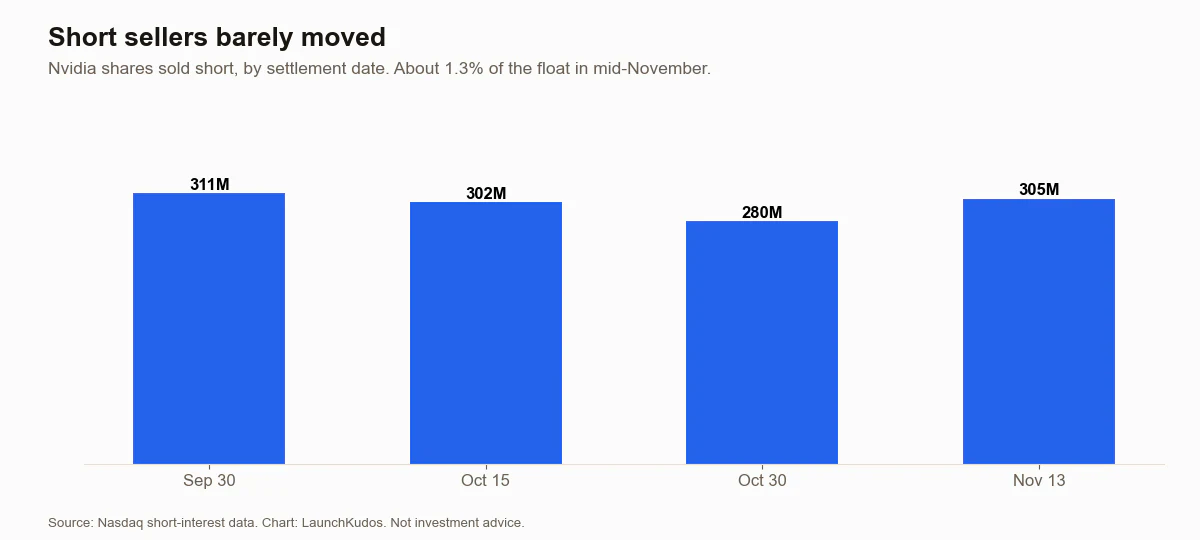 Source: Nasdaq short-interest data.
Short interest rose about 9% in early November, to 305 million shares. That's about 1.3% of the float, or one day of normal trading. It isn't a coordinated attack.
So who was selling? The day-by-day evidence
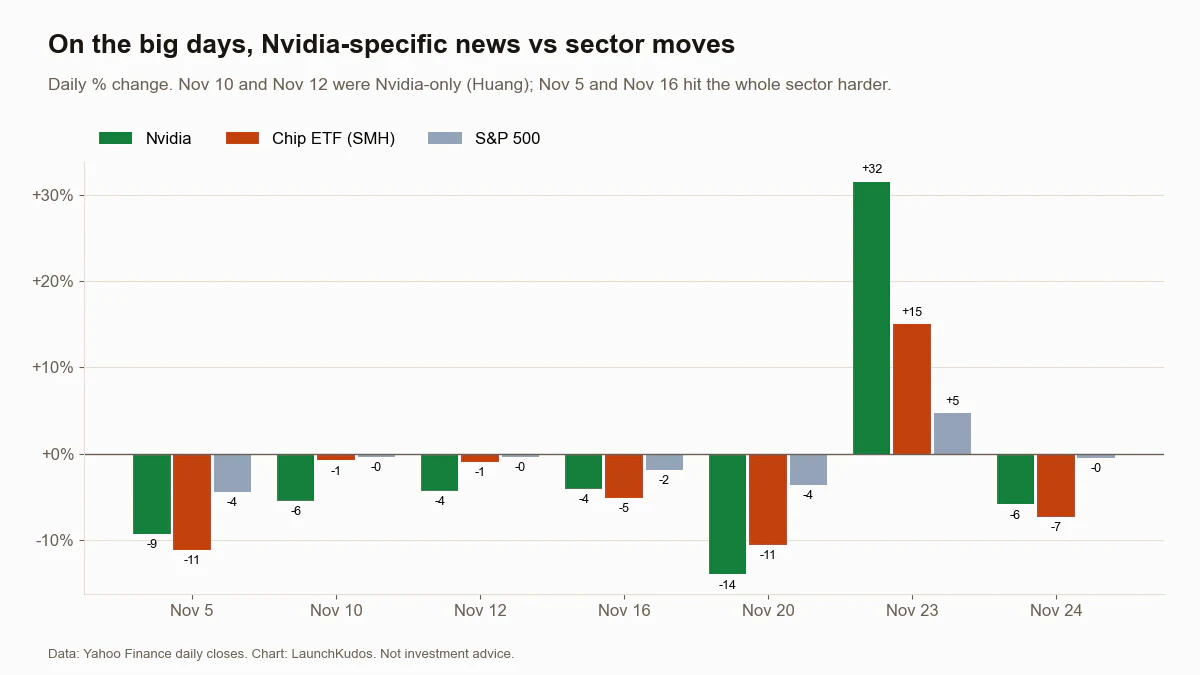 Daily % change. Data: Yahoo Finance.
Split the big days in two and a pattern appears:
Days that hit the whole sector harder than Nvidia (macro and policy selling):
- Nov 5: after Democrats won both houses of Congress, the chip ETF fell 11.2% and Nvidia 9.3%. Wedbush's Dan Ives lists "anti-AI/anti-datacenter" fears among seven reasons for the tech sell-off (Yahoo Finance).
- Nov 16: the US remote-access export rule. SMH −5.1%, Nvidia −4.1%.
- Nov 24: SMH −7.3%, Nvidia −5.9%, as Anthropic fell below its IPO price.
Days that were Nvidia-only (governance selling):
- Nov 10 and Nov 12: reports that the board would remove Huang, then the 8-K filing confirming his exit. Nvidia −5.5% and −4.3%, while SMH barely moved.
- Nov 20: Reuters reported the SEC is examining possible accounting issues at Nvidia (Reuters via Investing.com). Nvidia fell 14%, its worst day in the window. The SEC hasn't commented, and no wrongdoing has been found.
Then the reversal: Nov 23, Huang was reinstated and Nvidia rose 31.5% (our story).
The bears will feel validated after being doubters of the AI Revolution since early 2023 and will be louder and louder over the coming weeks and months. Yelling fire in a crowded theater moment is here and the bears will take center stage with this narrative and ultimately with Show more

This sell-off has been driven by a perfect storm created by: 1) The Blue Tidal Wave win and fears about an anti-AI/anti-datacenter DC, 2) losing the global leader of the AI Revolution Jensen in his black eye moment, 3) China driven regulatory concerns across the rest of
What about retail investors?
Retail went the other way. Vanda Research says retail investors bought $1.12 billion of Nvidia in the week of Nov 16–20, and the 3x leveraged semiconductor ETF SOXL drew its biggest monthly inflow in nine years (Business Insider via AOL).
Our synthesis: the selling came from professional funds cutting AI exposure. Their reasons were fund losses, money needed for the $81 billion Anthropic IPO, rising rates and Fed-hike bets, plus two Nvidia-specific shocks: the CEO's exit and the SEC report. Retail investors were the buyers. Insiders and short sellers were bit players.
Is Nvidia cheap now?
By one measure, yes. CNBC put Nvidia's forward price-to-earnings ratio at about 8.4x on Nov 20, after the stock fell while expected earnings didn't (CNBC). Revenue was $115.8 billion last quarter, up 103%, and interim CEO Kress guided 75% growth for next fiscal year. The seven-week losing streak was the longest since 2008.
Reader poll
What drove Nvidia's November sell-off most?
Vote to see results.
FAQ
Did Jensen Huang sell Nvidia stock in 2026?
No. His 2026 Form 4 filings show only stock awards, tax withholding and gifts, including a 58.96-million-share transfer to a trust in March. They show no open-market sales.
Who sold Nvidia stock in Q3 2026?
Per 13F filings, Renaissance (−99.7%), Bridgewater (−30.5%), Caxton, Schonfeld, Moore, Tudor and Soros cut their stakes. Third Point, Tiger and Appaloosa added, and hedge funds as a group were net buyers of about $5.9 billion.
How much of Nvidia is sold short?
About 305 million shares as of Nov 13, 2026: roughly 1.3% of the float, or about one day of trading volume.
Why did Nvidia stock fall 14% on Nov 20, 2026?
Reuters reported that the SEC is examining potential accounting issues at Nvidia. The SEC declined to comment, and no wrongdoing has been found.
Related: Is AI a bubble? · Nvidia reinstates Jensen Huang · Reliance: news vs stock
- #nvidia
- #insider-trading
- #13f
- #ai-stocks