Every advanced chip starts as a pattern of light. To print features a few nanometers wide, you need light with a very short wavelength, and a machine that can aim it to within the width of a few atoms. Only one company sells that machine: ASML, based in Veldhoven in the Netherlands.
This explainer shows what the machines are, how they work, why they're so hard to copy, and what that means for ASML's business. Every figure is sourced, and estimates are labeled as estimates.
What does ASML actually sell?
Lithography scanners. They shine light through a "reticle," a stencil of the chip's circuit, and shrink the pattern onto a silicon wafer coated with light-sensitive chemicals. A chip goes through this step dozens of times, once per layer. ASML sells three main families:
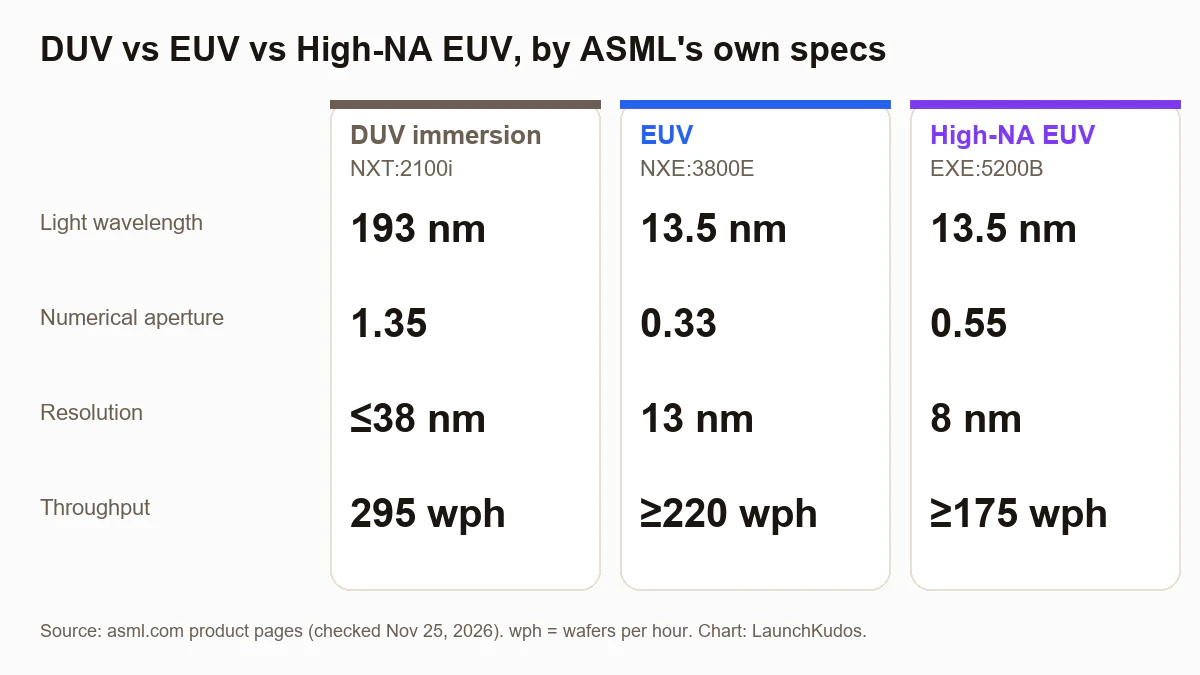 Source: ASML product pages, checked Nov 25, 2026.
- DUV (deep ultraviolet). 193-nanometer light. This is the workhorse for most chip layers, and the tools China can still partly buy.
- EUV (extreme ultraviolet). 13.5-nanometer light, about 14 times shorter than DUV. ASML says the NXE:3800E supports 2-nanometer logic chips.
- High-NA EUV. The same light through bigger optics: a numerical aperture of 0.55 instead of 0.33, for 8-nanometer resolution. The first one went to Intel in December 2023.
It also makes metrology and inspection tools (YieldStar, and HMI electron-beam systems) that measure how well each layer was printed.
How does an EUV machine make its light?
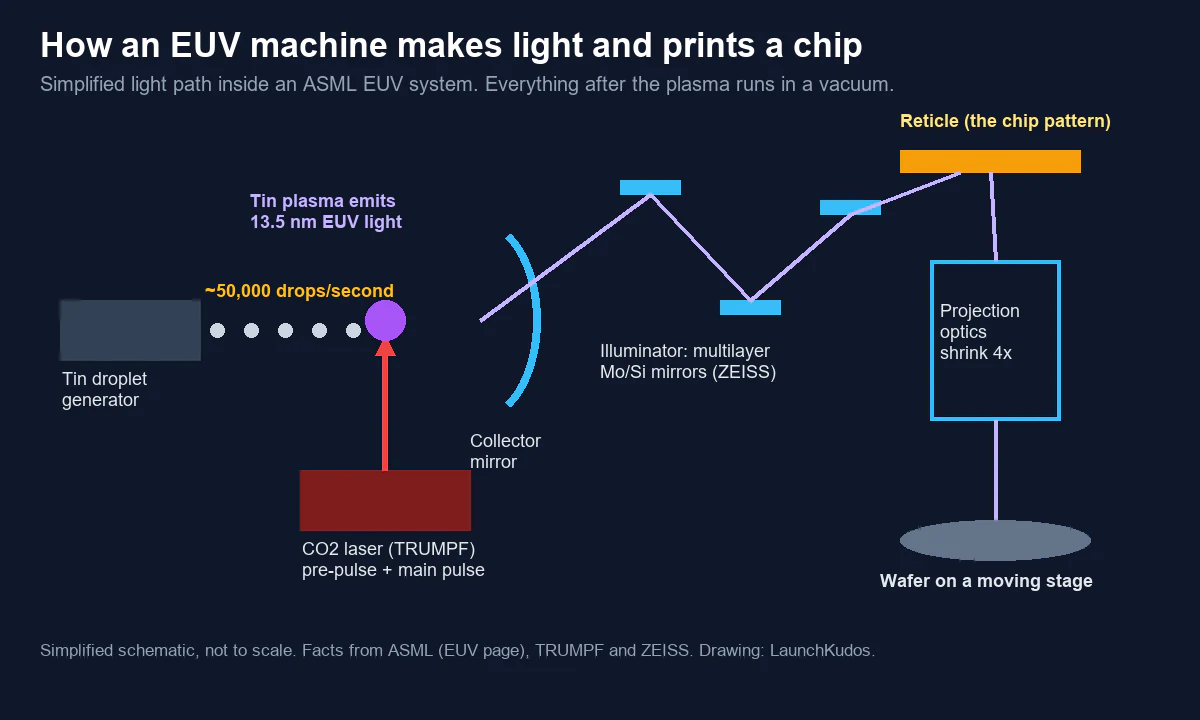 Simplified schematic, not to scale. Facts from ASML, TRUMPF and ZEISS.
- A droplet of tin. A generator fires tiny drops of molten tin into a vacuum chamber, up to 50,000 a second, according to ASML.
- Two laser pulses. A CO2 laser built by TRUMPF hits each drop twice: a weak pre-pulse flattens it into a pancake, then the main pulse vaporizes it into plasma. TRUMPF describes amplifying a seed pulse of a few watts more than 10,000-fold. Its pages quote tens of kilowatts of output; the exact figure varies by page, so we don't pin one down.
- Light from plasma. The plasma gives off 13.5-nanometer EUV light.
- Mirrors, not lenses. EUV light is absorbed by almost everything, including air and glass. So the whole light path is a vacuum, and the light is steered by mirrors coated with alternating layers of molybdenum and silicon, made by ZEISS. ZEISS says that if one of its High-NA mirrors were scaled to the size of Germany, its largest bump would be under 100 micrometers.
- Printing. The light reflects off the reticle, and projection optics shrink the pattern 4x onto the wafer. ASML says its wafer handling holds surface temperature uniform to within 2 thousandths of a degree.
ASML's own videos show it better than any diagram:
Why can't anyone copy it?
Planned supply for 2027–28 "will not fully meet the demand."
1. Thirty years of R&D, paid for partly by its customers
EUV research began in the 1980s, and ASML started industrializing it in 1994. It shipped demonstration tools in 2006 and its first production tool, the NXE:3300, in 2013. In 2012, Intel, TSMC and Samsung together put €1.38 billion into ASML's R&D and bought about 23% of the company for €3.85 billion, per ASML. The customers funded the tool they needed.
2. A supply chain nobody else can rebuild
The tin-plasma source came with ASML's 2013 purchase of Cymer. The laser comes from TRUMPF, and the optics from ZEISS. ZEISS says one High-NA optics module weighs about 12 tonnes and has more than 40,000 parts. Estimates of ASML's supplier count range from about 800 key suppliers (CNBC, 2022) to more than 5,000. We couldn't confirm an official figure, so treat it as "thousands." A High-NA system ships in "13 huge containers and 250 crates," according to Tom's Hardware. The same report put High-NA prices at about $300–400 million each.
3. Export controls
ASML has never been allowed to sell EUV to China. Since September 2024, even some advanced DUV models (NXT:1970i and 1980i) need Dutch export licences, CNBC reported. In April 2026, US bills to curb DUV sales to China knocked the stock down. JPMorgan's Sandeep Deshpande said earnings "could be reduced by up to 10%," per Reuters.
Can China catch up?
Reuters reported in December 2025 that a prototype in Shenzhen, built with former ASML engineers, can generate EUV light but hasn't made working chips, via Engadget. China's stated target is 2028. UBS says China is roughly where ASML was in 2004 and won't have viable EUV this decade, but could reach high-volume immersion DUV in two to five years, per The Next Web.
Our view: making EUV light isn't the hard part. Making it bright, steady and reliable enough to run 24 hours a day in a fab is. That's where the decades went. Japan's Canon is trying a different route, nanoimprint lithography that stamps patterns instead of projecting them. It shipped one tool to a Texas research institute in 2024, per Canon. That's not yet a threat at volume.
The business: record demand, a falling stock
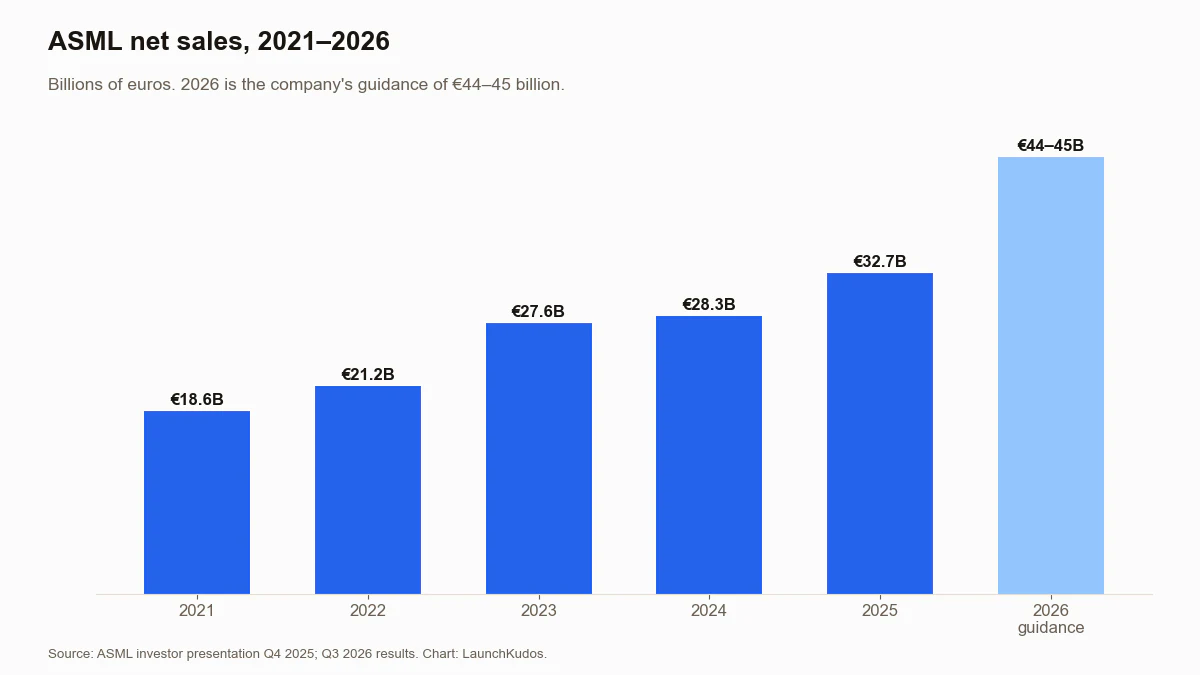 Source: ASML investor presentation and Q3 2026 results.
Q3 2026, from ASML's filing:
- Net sales: €11.66 billion
- Gross margin: 57.5%
- Net income: €4.96 billion
- Q4 guidance: €14.2–15.2 billion
On the earnings call, management said it expects about 65 EUV systems in 2026 (up from 48 in 2025), with China about 20% of 2026 sales. It also said Intel has run more than a million wafers on High-NA.
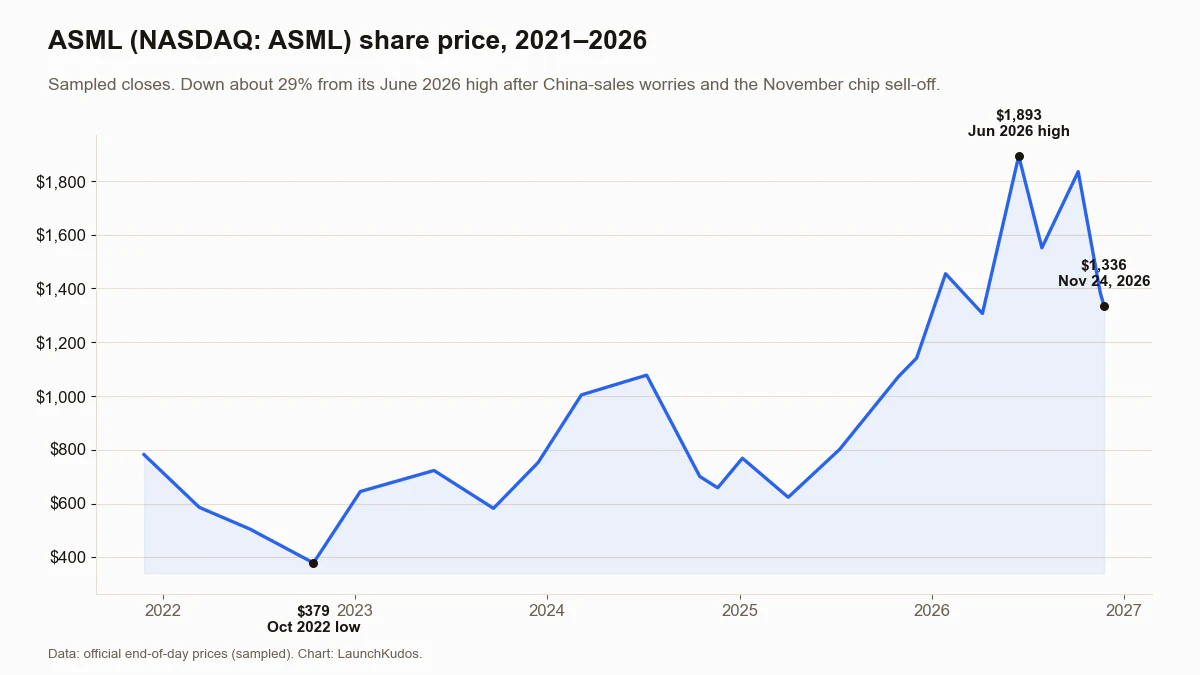 Sampled official closes. Not investment advice.
Reader poll
Will China build a working EUV machine by 2030?
Vote to see results.
FAQ
What does ASML make?
ASML makes lithography machines that print chip patterns onto silicon wafers: EUV, High-NA EUV and DUV scanners, plus measurement and inspection tools.
Why is EUV so important for AI chips?
EUV uses 13.5-nanometer light, which lets fabs print the tiny features of leading-edge chips in fewer steps. Every advanced AI GPU made at TSMC, Samsung or Intel goes through EUV lithography.
How much does an EUV machine cost?
ASML doesn't publish prices. Reports put standard EUV tools at more than $200 million and High-NA EUV at about $300–400 million each.
Can China buy ASML's EUV machines?
No. ASML has never been allowed to ship EUV to China, and since 2024 some advanced DUV models also need Dutch export licences.
Who competes with ASML?
Nobody sells EUV. Nikon and Canon make older DUV tools, and Canon is developing nanoimprint lithography. China is building a domestic EUV prototype that hasn't made working chips yet.
Related: Asia's AI supply chain in November · Nvidia's CEO saga and what founders should watch · War, oil and chip controls
- #asml
- #semiconductors
- #euv
- #ai-hardware